
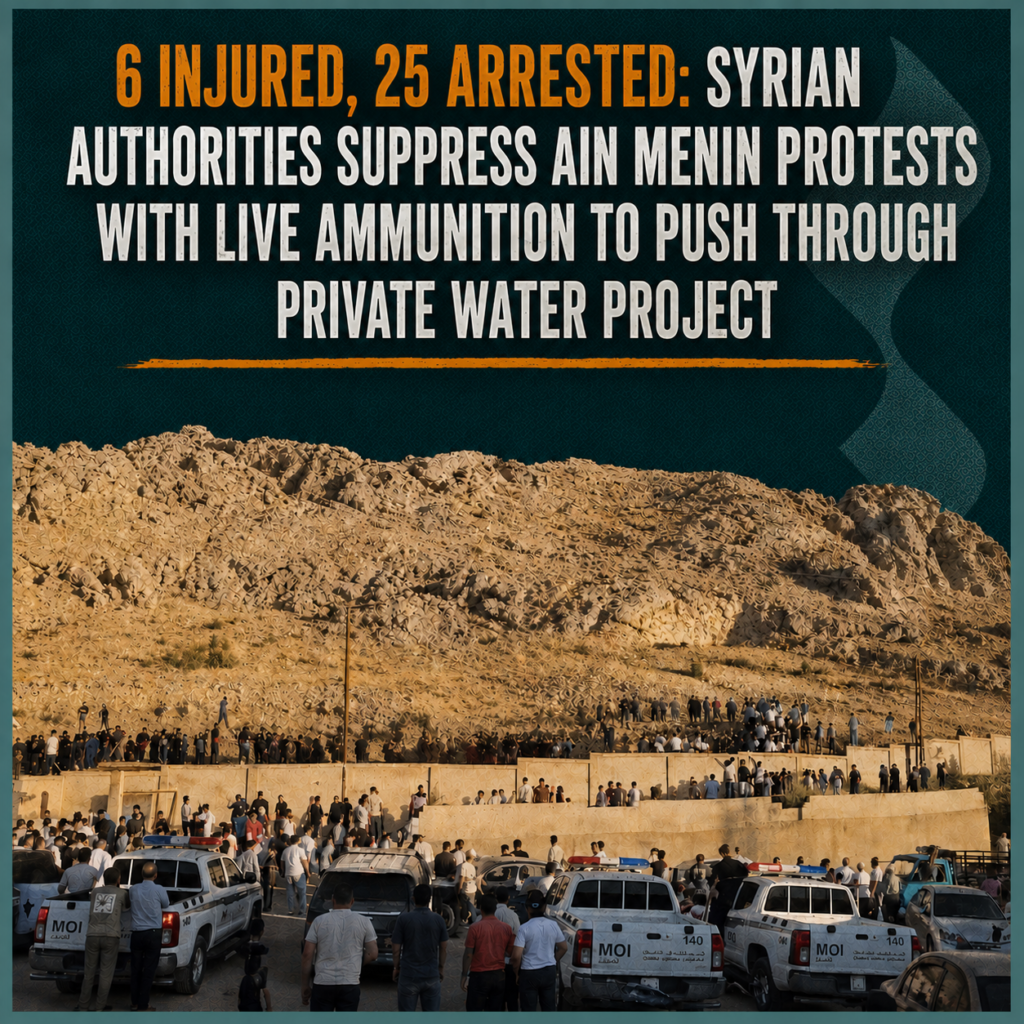
On Friday, July 31, 2026, the town of Ain Menin in the Damascus countryside witnessed a security and military intervention by Syrian government forces to disperse local protests rejecting a project to seize the town’s water resources. The intervention resulted in 6 civilians being injured by live ammunition and was accompanied by an arbitrary arrest campaign targeting 25 individuals. The repercussions of the event evolved to include the mass resignation of the local municipal council and a commercial strike that extended from the town to paralyze movement in major markets in the capital, Damascus, in a move that reflects local rejection of legal violations and trespassing on private property.
Trespassing on Private Property and Violating the Water Law
The crisis began with the deployment of heavy machinery to work in the “Baarjal” area within the administrative borders of Ain Menin. While government authorities and the water establishment stated that the works were limited to cleaning and dredging well No. (14) to support the neighboring city of Al-Tal, the townspeople presented field and legal data that refutes the official narrative, summarized in the following points:
-
Drilling a new well on private property: The machinery began drilling an entirely new well inside privately owned land belonging to a local resident. Despite the owner filing a lawsuit before the Public Prosecutor to stop the trespass, the work continued under the protection of security apparatuses, bypassing the judicial process.
-
Execution through private contractors: It became clear that the drilling rig used at the site did not belong to the General Establishment for Drinking Water and Sewerage, but rather to a private contractor backed by influential figures, sparking local accusations of efforts to commodify and trade water.
-
Bypassing the 2005 Water Law: The residents base their rejection of the project on Law No. 12-05, which stipulates the priority of meeting the basic needs of the local population before transferring water to other areas. Ain Menin currently suffers from a severe shortage, as water only reaches it once every two weeks.
The Use of Live Ammunition and the Arrest Campaign
In response to the continuation of the drilling work, a number of the townspeople gathered after Friday prayers and headed towards the wells area to protest and demand the removal of the machinery. This move was met with a security cordon by the Internal Security Forces, backed by reinforcements from the Baarjal military camp.
-
Gunfire and documented injuries: Security forces used live ammunition heavily and indiscriminately to disperse the protesters. According to documented field data, the excessive use of force resulted in 6 direct injuries among civilians, refuting official statements claiming the damages were merely the result of a stampede.
-
Arbitrary arrests: The security apparatuses carried out raid and arrest campaigns that targeted 25 individuals from the town, including university students, workers, and shop owners.
-
Security threats: The detentions were accompanied by explicit threats from a security official in Al-Tal to transfer the detained youths to the “Fourth Division.” As of now, only 3 detainees have been released, while the rest remain detained without legal justification.
Mass Resignation and the Economic Spillover of the Protest
The repercussions of the security intervention were not limited to the field; they took administrative and economic paths that formed a tool of civil pressure on the central authorities:
-
Resignation of the Municipal Council: The head and members of the Ain Menin Municipal Council announced their mass resignation and total abstention from exercising their duties, in a move aimed at stripping the cover off the security intervention and rejecting the official narrative, demanding the immediate release of the 25 detainees and an end to the trespassing on private property.
-
Damascus markets strike: On August 2, 2026, residents held a sit-in at the “Bahra Roundabout,” accompanied by a comprehensive commercial strike in the town. The protest movement quickly spread to the capital, Damascus, where merchants originating from Ain Menin closed their shops in major and sensitive markets, most notably the “Al-Hariqa” and “Al-Souf” markets, in solidarity with the detainees. The residents are still continuing their protest sit-in today, demanding the immediate release of all detainees.
Ultimately, the events in Ain Menin do not represent merely a local dispute over resources; they expose a deeply rooted governmental approach that relies on systematic repression as the sole tool for crisis management. The ease of resorting to live ammunition to impose illegal projects proves the transformation of state institutions into a front for comprehensive monopolization; where natural resources, and even drops of water, are treated as personal investments and exclusive economic shares for power networks affiliated with the authority. Faced with this mentality that confiscates the most basic necessities of life and violates private property to consolidate its absolute dominance, the steadfastness of the residents and their economic disobedience confirms that the security grip, no matter how tight, is no longer capable of breaking the will of communities whose rights are stripped and resources are monopolized by force of arms.