
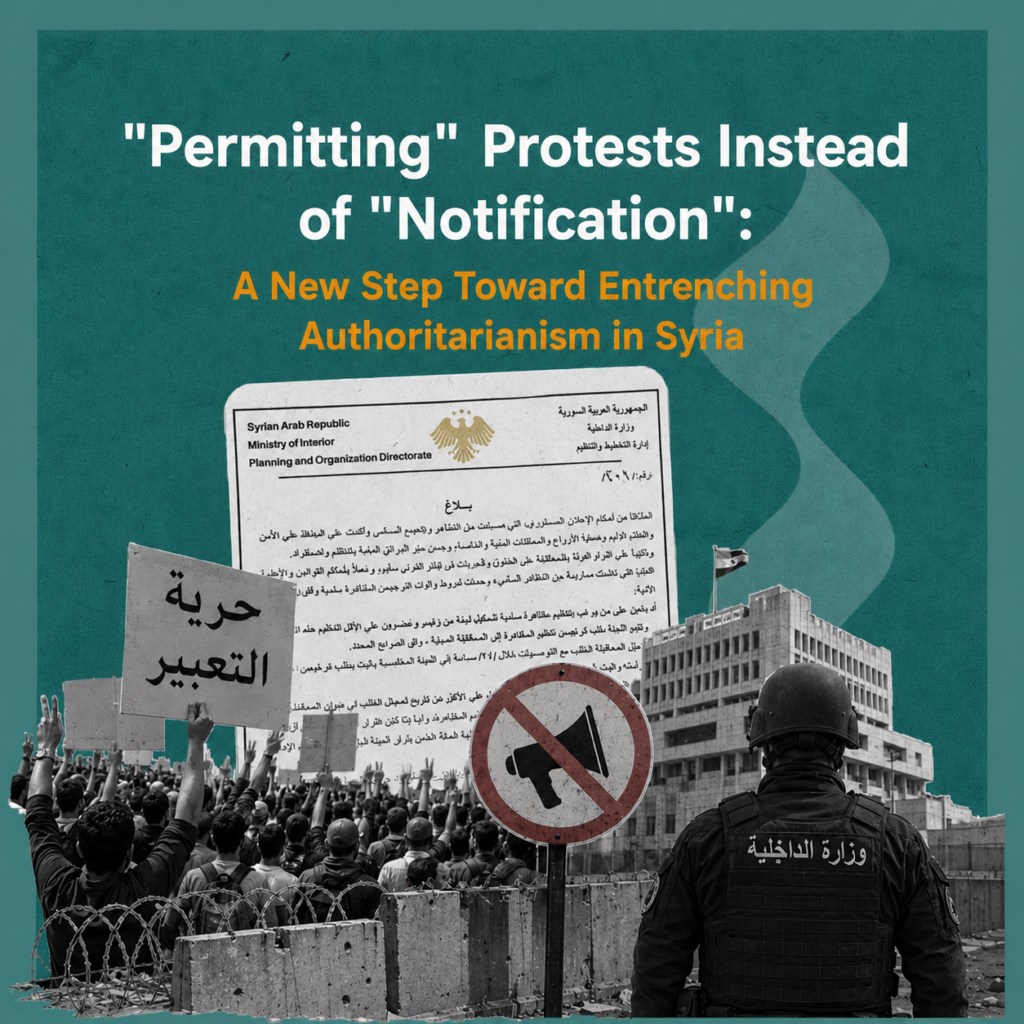
The Syrian Ministry of Interior has issued a new circular mandating a “permit” system for public gatherings and peaceful demonstrations, a move that has sparked widespread controversy regarding the future of public liberties and the constitutionally guaranteed right to expression.
A Security Grip with Legal Cover
According to the circular issued by the Planning and Organization Department, those wishing to organize any demonstration must now form a committee and submit an official permit request to the relevant governorate within a specified timeframe. Although the circular stipulates the right to appeal in the event of a rejection, the broad powers granted to authorities to approve or deny place this right at the mercy of prior security and administrative decisions.
Karam Shaar: The Power to Prohibit Undermines the Constitution
Commenting on these developments, researcher and economist Dr. Karam Shaar stated that adopting a “permit” system effectively grants the state absolute authority to accept or reject the right to protest. Shaar explained that this measure contradicts the constitutional declaration that guarantees the right to peaceful assembly, describing the step as a “clear direction toward reinforcing authoritarianism.”
“The state now has the authority to approve or reject the right to protest guaranteed by the constitution… it is a step toward authoritarianism.” — Dr. Karam Shaar
Violation of International Standards
Shaar compared this measure to the practices followed in most advanced and democratic countries, where a “notification” policy prevails. In such systems, protesters merely notify authorities of the time and place of the gathering to enable logistical organization and public safety protection, without the authority having the right to confiscate opinion or prevent the assembly through a prior decision.
Implications of the Decision
This circular comes at a time when some Syrian regions are witnessing demands-based movements and economic protests. Observers interpret this as an attempt to frame any future popular movement within administrative templates that allow authorities to terminate demonstrations immediately if they “exceed the limits of the permit” or are deemed a “breach of public order” at the ministry’s discretion. This legal measure represents a radical shift in how Syrian authorities handle civil rights, moving the right to expression from the category of an “original constitutional practice” to that of a “conditional administrative grant.” Consequently, this new system tightens the legal siege on any potential popular movement, prioritizing security considerations over constitutional principles.