
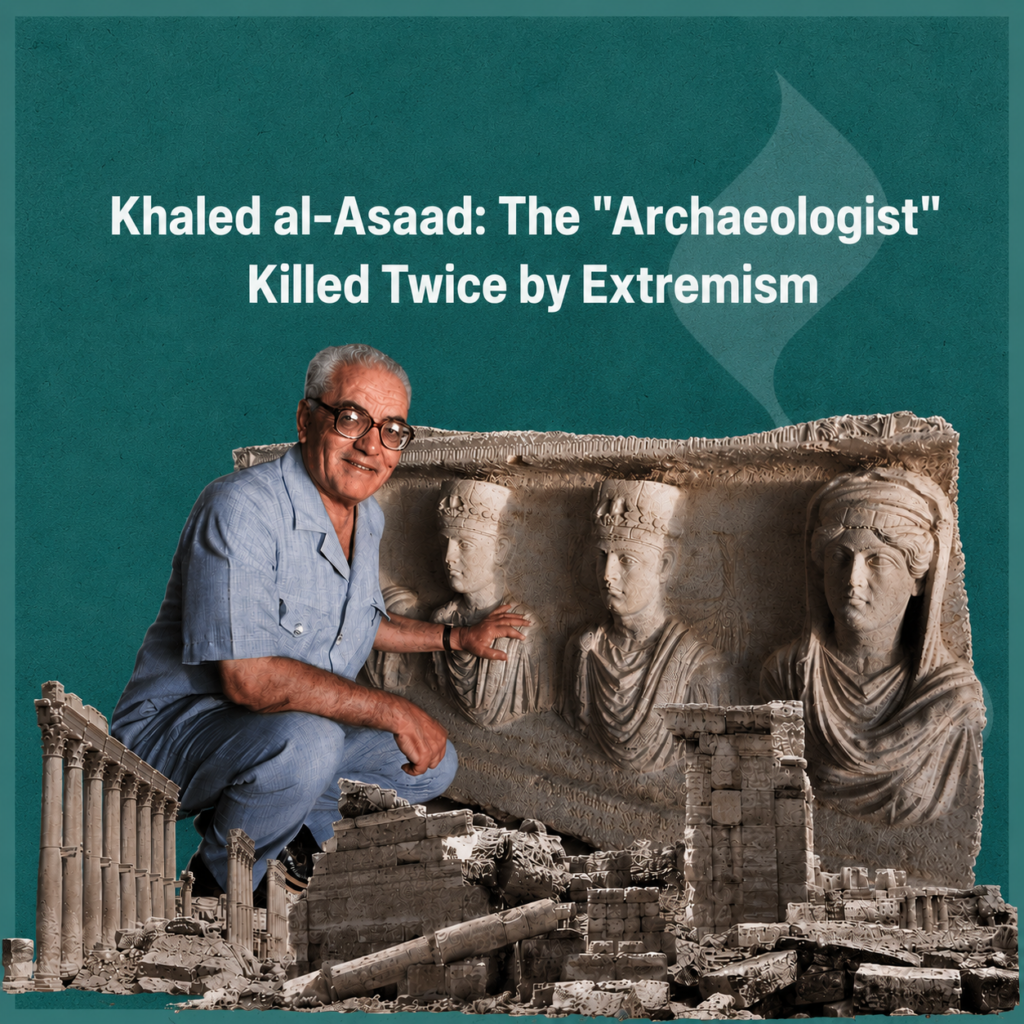
While international museums in Italy bow in reverence to his memory, and global archaeological awards are established in his name as an icon of human resilience, the name of Syrian archaeologist Khaled al-Asaad faces a new attempt at moral assassination in his own hometown. In a move that has sparked widespread public and cultural outrage, local authorities affiliated with the “Jolani leadership” (Hay’at Tahrir al-Sham) have removed al-Asaad’s name from one of Palmyra’s schools, reverting it to the generic “Palmyra Secondary School.” This act is seen as a blatant attempt to erase the memory of the man who sacrificed his life for the city’s history.
The Guardian of Secrets Who Never Bowed
Khaled al-Asaad was not merely an archaeological researcher; he was a man who lived 81 years, spending over forty of them as the Director of Antiquities in Palmyra. To him, the columns and statues were not just silent stones, but a Syrian identity and a civilizational extension of all humanity.
In 2015, when the terrorist organization “ISIS” invaded the city, many fled seeking safety, but al-Asaad refused to leave. He stood alone against the storm of extremism, realizing that his final mission was to protect the city’s treasures. He hid the precious artifacts, and when the organization captured and tortured him for weeks to reveal their location, he met their whips with the silence of Palmyra’s mountains.
On August 18, 2015, one of the most heinous cultural and humanitarian crimes was committed. He was executed and his body was hung in the public square. The killers labeled him the “Guardian of Idols,” yet al-Asaad passed away leaving behind a testament written in blood: “History is not for sale, and dignity is non-negotiable.”
The World Honors… While the “De Facto Authority” Erases
The stark contrast today is painful for every Syrian. While the Italian city of Arona named its national museum after him, and European cultural institutions raced to immortalize his memory with international awards, the “Jolani authority” comes to practice another form of “symbolic execution.”
“Removing al-Asaad’s name from a school in his city is not just an administrative procedure; it is a continuation of the methodology used by his first killers. Both see national memory as an enemy and enlightened symbols as a threat.” — (A resident of Palmyra who preferred to remain anonymous)
Implications of the Move: A War on Identity
Observers believe this behavior reflects the radical ideology that “New Syria” (according to the vision of extremist factions) is trying to establish—a vision based on:
-
Eliminating National Symbols: Specifically those associated with ancient Syrian civilization or modern history that does not align with their strict doctrine.
-
Erasing Aesthetic Memory: Treating heritage and history as “idols” or a legacy that must be obliterated.
-
Sending Political Messages: Asserting that loyalty belongs to the faction and its narrow ideology, not to the nation and its historical icons.
Conclusion: The Stone Remains, Names Are Indelible
Authorities may succeed in tearing a plaque off a school wall, but they will never succeed in uprooting Khaled al-Asaad from the history books or the hearts of the people of Palmyra and all Syrians. Al-Asaad remains the “Guardian of Antiquities” and a martyr for beauty, while transient names fade into oblivion.
The attempt to erase the name of Khaled al-Asaad is a resounding confirmation that the conflict in Syria is not merely political; it is a battle for consciousness and identity between those who see history as the roots of life, and those who see it merely as “idols” deserving of destruction.