
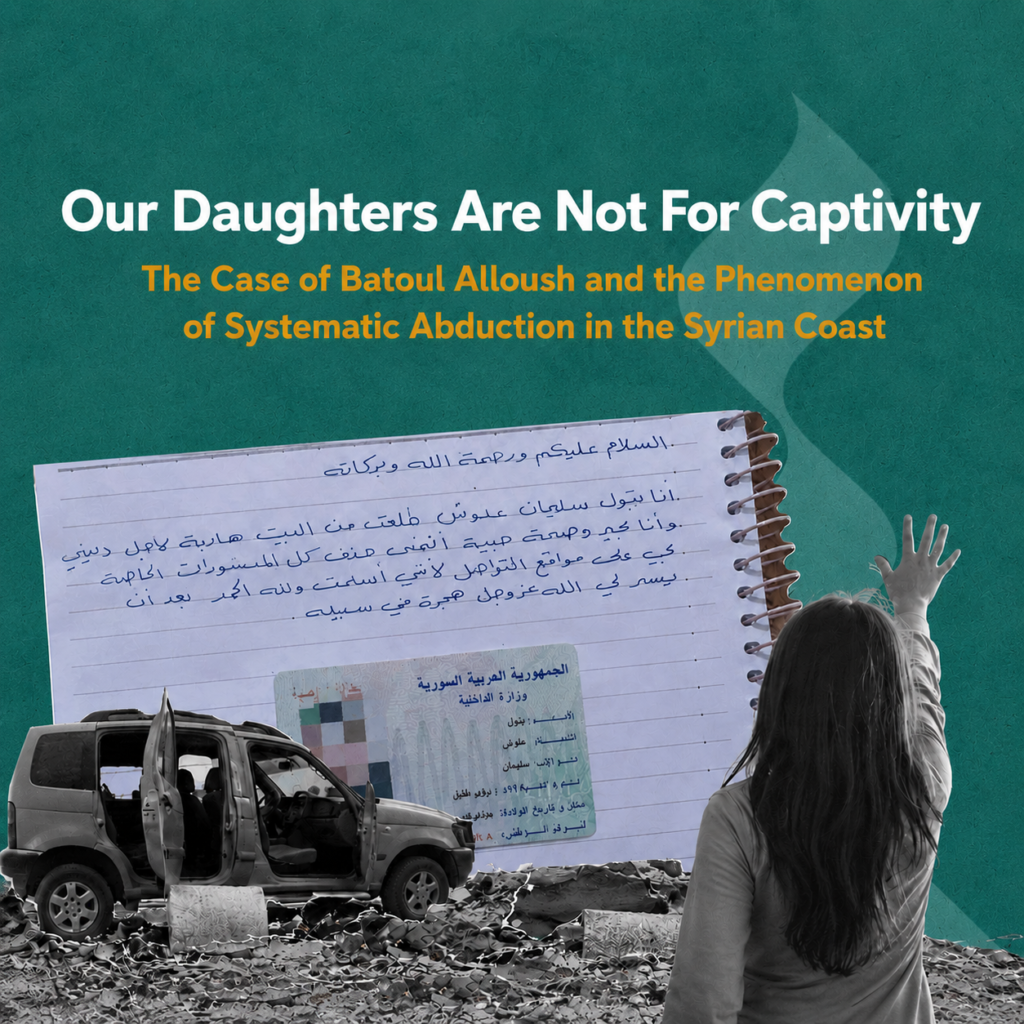
The student Batoul Suleiman Alloush is not an isolated case, but a link in a systematic series of crimes occurring in the Syrian coast. These incidents follow a pattern where clear security abductions are transformed into staged media appearances days after the victim’s disappearance, using the pretext of “migration” to divert justice and silence the families.
Circumstances of the Abduction from Latakia University
The case follows a trajectory documented in dozens of previous incidents:
-
The process begins with an abduction from the gates of Latakia University or from within the university housing campus.
-
The abduction occurs in an environment that is supposedly under strict security supervision.
-
After days of disappearance, the victim is forced to appear in a video clip wearing a hijab, which is contrary to her usual appearance.
-
In the video, she is compelled to state that she is “fine and in good health” and that she left of her own volition.
Content of the Handwritten Message Attributed to Batoul Alloush
A handwritten letter was found placed next to Batoul’s ID card. The text of the message stated:
“I am Batoul Suleiman Alloush. I left home fleeing for my religion. I am fine and in good health. I hope all posts regarding me are deleted… because, thank God, I have converted to Islam after God Almighty facilitated a migration in His cause for me.”
The victim’s family and the local public consider this letter a carbon copy of messages forced upon other girls snatched from universities in the same manner to portray the kidnapping as a “religious dispute.”
The Established Protocol in Regional Abduction Incidents
The evidence in this case reveals a recurring protocol followed by the abducting groups:
-
Field Targeting: Monitoring and seizing girls in front of educational facilities like Latakia University.
-
Disappearance Period: Severing all communication with the family for several days to exert physical and psychological pressure.
-
Media Exploitation: Forcing the victim to wear a hijab and claim she is “fleeing for her religion” due to family pressure to legally justify the crime.
-
Administrative Cover-up: Accusations against officials, such as Yasser Khalifa, for erasing surveillance footage at the university and housing gates to hide the perpetrators’ identities.
Identification of the Filming Location in Jableh
Activists succeeded in identifying the specific location where the recent video of Batoul was filmed:
-
The video was filmed on the Jableh Corniche near a well-known villa.
-
The filming location is only 200 meters away from the “Public Security” center.
-
This proximity raises serious questions regarding the freedom of movement enjoyed by kidnappers in heavily secured areas.
Public Reaction and the Mother’s Testimony
Significant anger has spread through Jableh, Baniyas, Latakia, and Damascus Under the banner of Our Daughters Are Not For Captivity.
Batoul’s mother appeared in a recorded video refuting the “migration” narrative. She confirmed that her daughter was kidnapped from her university and was forced to appear in a dress and use rhetoric that does not reflect her true will or background.
The repetition of this scenario with dozens of girls suggests an organized activity targeting social components in the Syrian coast amid a notable official silence.