
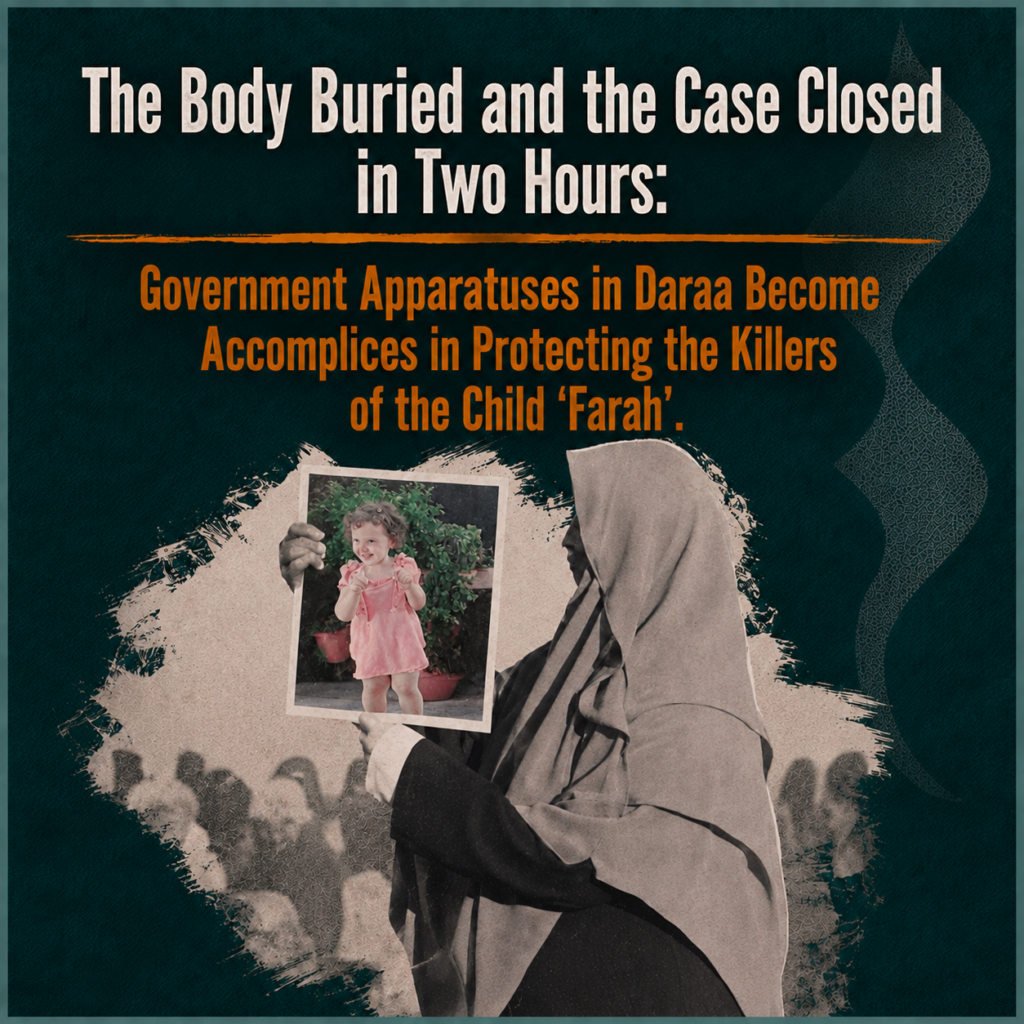
In a tragic incident that shook the town of Ghabaghib in Daraa governorate, popular anger and demands for justice are escalating following the murder of the child “Farah Al-Hammoud” under mysterious circumstances. This comes amid explicit accusations from her family against gold and antiquities excavation networks, and widespread condemnation of the complicity of the Syrian government’s security apparatuses in covering up for the real perpetrators and immediately obliterating the features of the crime.
Residents who took part in angry protest vigils, chanting “The people want to reveal the truth,” did not only demand retribution, but also the opening of a transparent and fair investigation that exposes those involved in the crime and those who contributed to its cover-up, in light of a complete lack of trust in local security apparatuses and government institutions.
Disappearance Within Minutes
The details of the crime, as recounted by “Rahaf Abboud,” the victim’s mother, indicate that Farah disappeared within just ten minutes inside a nearly closed residential neighborhood. Testimonies of neighbors at the beginning and end of the street confirm that the little girl never left the area.
The mother points the finger of blame directly at a group of individuals living in the same neighborhood who practice digging and excavating for gold and antiquities inside their homes. The physical evidence found on the child’s body, including lacerations on the neck, wrist, and foot, suggests the possibility that the child was used as a “Rasad” (human sacrifice) in sorcery rituals associated with extracting buried treasures—a dangerous phenomenon that has begun to spread among excavators.
Security Apparatuses: Direct Complicity and a Swift Government Cover-Up
The most alarming aspect of this case, which reflects a systematic pattern in dealing with violations and crimes, is the security and government response aimed at obscuring the truth. According to the family’s testimony, the Ghabaghib sub-district police refused to respond to demands to search the suspects’ homes, failed to conduct any initial investigative procedures, and completely ignored the family’s complaints, had it not been for the personal efforts of the victim’s father.
When the investigation was transferred to the governorate center in Daraa, the family was confronted with security behavior that lacked the minimum human rights and legal standards. The child’s mother states that the investigators mocked the family’s demands and attempted to close the file by pinning the charge on a 14-year-old minor.
The mother adds in her testimony: “When we told them that we are not convinced by this talk, they mocked us and started laughing.. and within two hours, they had taken my daughter to the forensic medicine department, brought her back, and buried her, claiming that the minor girl had enacted the crime!”
These suspiciously accelerated government procedures, represented by inventing a charade to enact the crime, concluding the forensic procedures, and burying the body within only two hours, categorically confirm the government apparatuses’ endeavor to cover up the details of the case and close the file immediately. This rush to turn the page cannot be read within the context of normal criminal procedures; rather, it proves the existence of official complicity to protect the real perpetrators and antiquities excavation networks, which seemingly enjoy security cover and government protection shielding them from any accountability.
Societal Fears and Demands for Transparency
The case of Farah Al-Hammoud is no longer merely a criminal offense; it has transformed into a public opinion issue that touches upon the security of every child in the region. “Limar Hammoud,” the victim’s cousin, summarizes these fears, saying: “If Farah is gone today, tomorrow it will be us. We want fair retribution.”
For her part, “Fatima Abboud,” the child’s aunt, stressed the necessity of conducting a fair and transparent investigation, while “Issam Hijazi,” a resident of Ghabaghib town participating in the protests, confirmed that the gathering is a message of solidarity and a demand to uncover the truth as it is: “How she was killed, who killed her, and who covered up the crime.”
Today, the murder of the child “Farah” is no longer an isolated incident, but rather a reflection of a comprehensive collapse in the security system and a total absence of state institutions that now stand as bystanders, or actual partners, in the face of the spread of organized crime. What Daraa is witnessing in terms of the dominance of excavation networks and their security protection perfectly mirrors what is happening in other Syrian regions, such as the spread and expansion of kidnapping and extortion networks in the Syrian coast, where these networks expand and brutalize under the eyes of government apparatuses that provide them with cover. The cry of Farah’s family today summarizes the terror of Syrians in light of the outbreak of crimes and the state’s abandonment of its role, with its apparatuses turning into a partner that protects criminals and obscures facts instead of protecting citizens’ lives.