
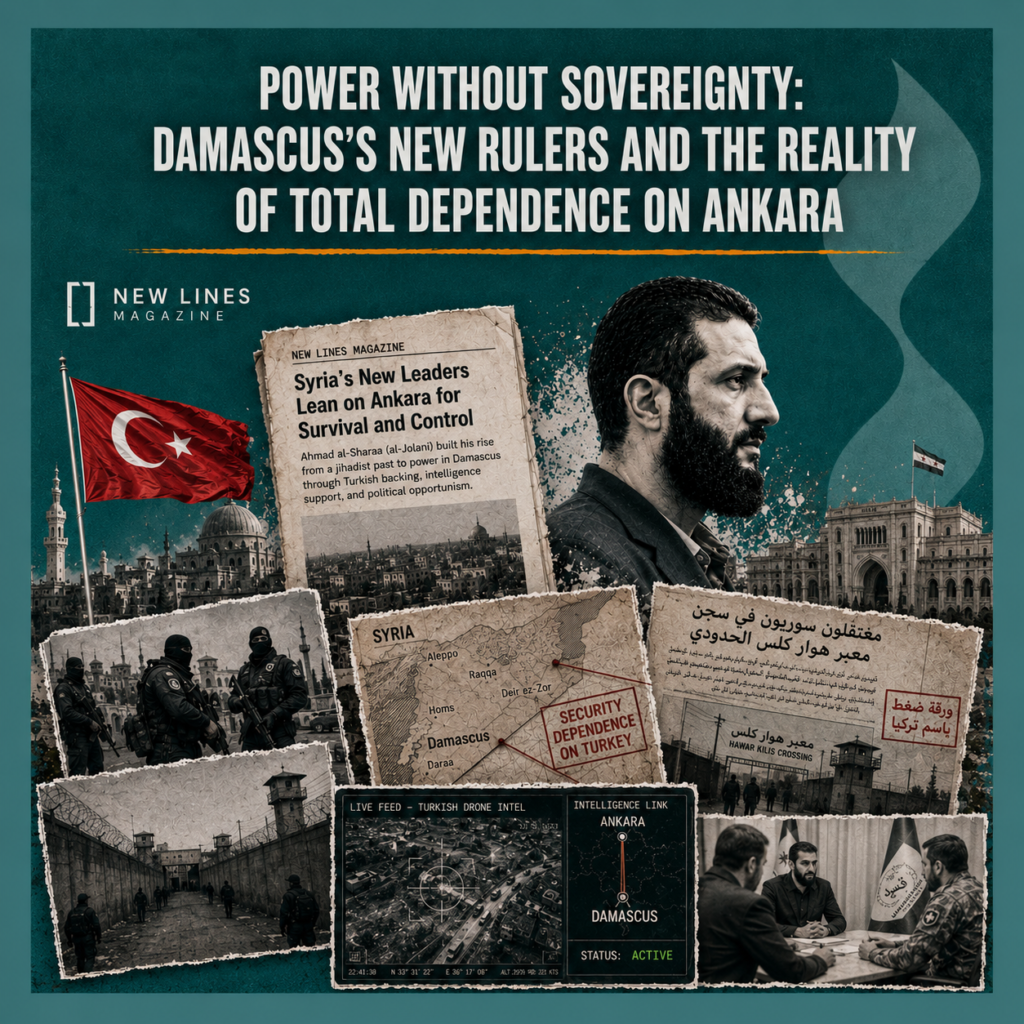
In an extensive analytical report published by New Lines Magazine—whose logo is attached in the file image_3d4c1e.png—the deep political and security realities of the new Syrian leadership in Damascus, headed by Ahmad al-Sharaa (al-Jolani), are revealed. The report deconstructs the current power structure, highlighting a government that lacks actual sovereignty and manages the country’s affairs through total reliance on foreign powers. It rests on an extremist past and political opportunism, with its sole objective being to consolidate its influence and ensure its survival in power at any cost.
An Extremist Past and Monopoly on Power
The current leadership did not emerge from a unifying national project, but rather rests on a clear and documented historical background. The current transitional president previously led a jihadist faction known as Jabhat al-Nusra, which evolved from a small cell of about 20 members in late 2011 to become the ruling power in Syria today. This rise to power was achieved through a relentless and, at times, ruthless strategy by the top leadership to consume the arena and impose absolute control.
Security Dependence and Intelligence Vacuum
Given the fragility of the foundation upon which this new authority is built, the Damascus government has found itself forced to rely fundamentally on Ankara’s protection. Despite its repeated attempts to demonstrate independence, data from New Lines Magazine confirms that the new Syrian regime remains tethered to, and derives its actual power from, Turkish support. The current Syrian state is weak, faces the threat of three different insurgencies on the coast, in the desert, and in the east, and lacks the ability to impose control on its own.
Due to Damascus’s lack of the intelligence and military capabilities required to run a state, Turkey is filling this security vacuum. Turkish drones provided live intelligence to Syrian security forces to fend off rebel attacks in 2025, and heavily participated in providing intelligence coverage during the blitz campaign against the Syrian Democratic Forces (SDF) in early 2026.
A Partnership in Oppression and Prisons Without Accountability
However, this security partnership is not limited to military support; it extends to practices that contradict the official rhetoric of the Damascus government. Turkish intelligence continues to operate a prison holding Syrian inmates at the Hawar Kilis crossing, a facility notorious for its inhumane conditions and the use of torture against detainees. The new Syrian state became directly involved in this dark security file when it took custody of several detainees in mid-2025 and transferred them to the al-Rai prison, reflecting a continuation of the old security approach with new tools.
Political Opportunism and the Search for New Legitimacy
In an attempt to expand its financial and political influence, the Damascus leadership has resorted to pragmatic politics and the manipulation of alliances. This became apparent just three weeks after taking power, when al-Sharaa gave his first interview to the Saudi channel Al Arabiya, and chose Saudi Arabia as the destination for his first foreign trip. This move aims at a tactical distancing from his initial allies (Turkey and Qatar), seeking to gain leverage and balance regional axes to secure direct financial support, especially given Turkey’s limited ability to invest and pump money into Syria.
Negotiating Deception and Exploitation of Tutelage
This manipulation did not stop at external borders but extended to the Syrian interior, where al-Jolani demonstrated deceptive tactics during his negotiations with the SDF. Damascus sometimes claimed that Turkey opposed certain terms, using Ankara as a pretext to pressure Kurdish negotiators into extracting field and political concessions that serve to consolidate his centralized authority.
A Fragile Authority Seeking Survival
In light of the investigations conveyed by the magazine, the picture of Syria under the rule of Ahmad al-Sharaa and his new government becomes clear: a fragile state run by an authority seeking survival by any means. On the one hand, it is intelligence-wise and militarily beholden to Turkey, which guarantees its continuation. On the other hand, it attempts to polish its regional image to transcend its past and secure political and financial cover. This combination of foreign dependence and political opportunism confirms that the current government places its narrow authoritarian interests above any consideration for true national sovereignty and sustainable stability for the country.