
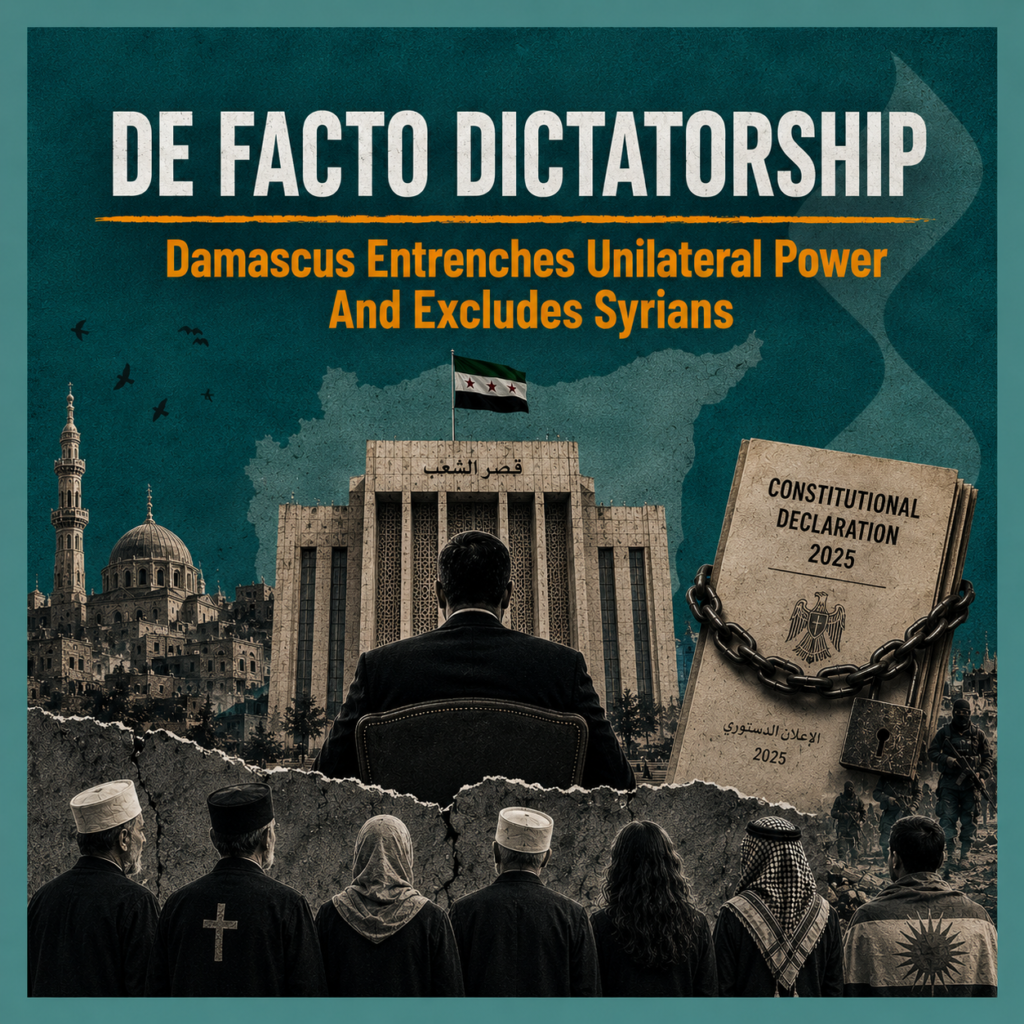
The page of the previous regime in Syria has been turned, yet a new dictatorship wearing the cloak of the “revolution” is clearly beginning to take shape on the ruins of state institutions. Since December 2024, Syrians believed the wheel of history had finally turned toward a state of law and fair representation, but today’s political scene reveals a bitter disappointment. The authority that inherited the reins of power is not presenting a transitional national project; rather, it is reproducing the tools of tyranny and adapting them to ensure its own survival. Instead of embarking on the hard work of building genuine institutional and constitutional legitimacy, we see a government today relying on freezing “revolutionary legitimacy,” transforming it from a historic moment of liberation into a permanent indulgence that justifies its eternal monopoly on power and the exclusion of anyone who does not pledge loyalty to it.
False Pragmatism and an Inerasable History
The new authority cannot erase its history simply by altering its rhetoric. Hayat Tahrir al-Sham (HTS), designated as a terrorist organization by the United States since 2018, carries an inheritance burdened by violent transgressions during its “Jabhat al-Nusra” era and a track record of repressing opponents in Idlib. Today, it is attempting to market itself through a pragmatic “technocratic” facade.
However, this tactical shift fools no one. A political movement cannot simply declare its ideological history null and void in the present. The Syrian communities now under its administration—from Kurds, Christians, Druze, and Alawites, to secular civil blocs—have profound and fundamental reasons to be terrified of this authority. These fears will not be dispelled merely by launching empty rhetorical reassurances that are unsupported by any genuine structural change in the decision-making apparatus.
The 2025 Constitutional Declaration: Legitimizing Despotism
In a desperate attempt to acquire a legal status, the new authority presented the “2025 Constitutional Declaration.” Although at first glance it may seem like a step toward institutionalizing the transitional phase, a closer look reveals a dangerous trend toward concentrating and monopolizing power, without establishing any real mechanisms for institutional accountability.
According to the rigorous analytical perspective of political legitimacy, any rule is only legitimate if its laws conform to values shared by the entire community, and if it is founded on the free and clearly expressed consent of the governed. The new Constitutional Declaration fails miserably on both conditions. It imposes rules that do not reflect Syrian political and societal diversity, and it lacks any trace of genuine popular consent through comprehensive electoral mechanisms or open political negotiation.
“Political exclusion, however it is achieved and however justified it appears in the immediate post-conflict period, remains the most accurate and reliable predictor of the recurrence of civil war.”
The Stability Trap: Monopolizing Power Paves the Way to Ruin
The new government uses the fragility of the security situation as a pretext to impose its unilateral control, claiming that “stability” and “securing institutions” must precede political openness. Although this excuse seems tempting to avoid chaos, it masks clear authoritarian intentions to postpone any democratic milestone indefinitely.
Seeking stability through authoritarian brutality and the exclusion of others is not a solution to the Syrian crisis; rather, it is a postponement of its explosion. Relying on coercive force and monopolizing the political arena under the pretext of maintaining state cohesion is a proven recipe for the collapse of nations. Comparative studies of post-conflict periods confirm that monopolizing the “liberation” narrative and accusing dissenters of treason does not produce stability, but rather accumulates anger. Any regime that views peaceful opposition and inclusive political participation as a threat to its stability is a regime planting the seeds of its next civil war with its own hands.
Furthermore, the new government stands entirely helpless in the face of ongoing violations of Syrian sovereignty, such as Israeli military expansion in the south and the widening of buffer zones. This proves that its lack of internal legitimacy is coupled with a severe inability to protect the state’s resources and preserve its territorial integrity.
An Authority Eroding from Within
Those who fail to improve the daily lives of Syrians will exhaust their revolutionary capital much faster than they imagine. Building a state on the ruins of destroyed institutions cannot be achieved through an authority that refuses to concede its privileges and excludes national partners.
What Syria is witnessing today is not a political transition for the better, but rather a “recycling” of totalitarianism under new banners. If this authority continues to ignore the conditions of constitutional and representative legitimacy, alongside the genuine demands of minorities and marginalized groups in Suwayda and elsewhere, it not only places itself in the face of internal and international isolation but also sets the stage for a new round of conflict. It proves to Syrians that turning the page on a dark era does not necessarily mean deliverance from the system of tyranny when it is reproduced with new faces and tools.