
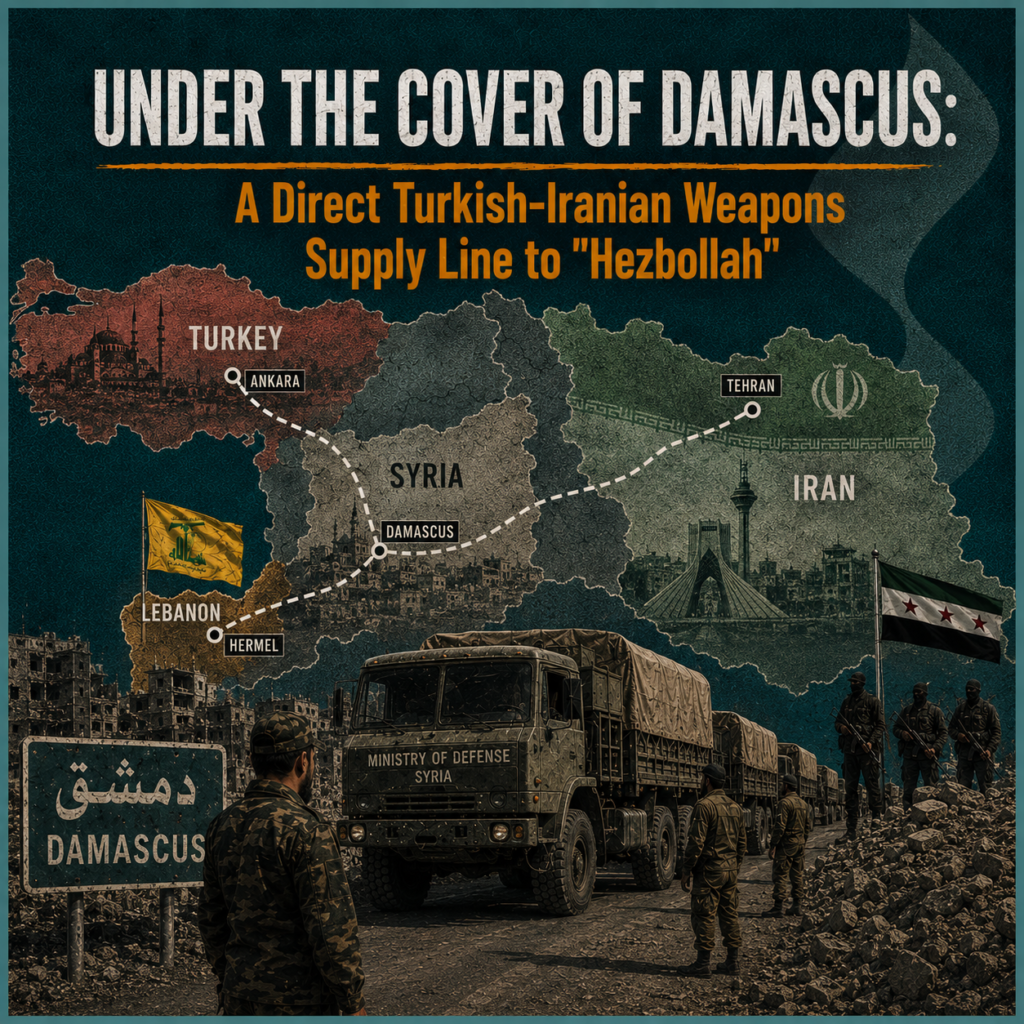
Syria is no longer a sovereign state, but has turned into a mere transit corridor managed by regional powers to settle their scores and feed their proxies through government institutions completely subservient to foreign will.
In a new confirmation of Damascus’s absolute subordination to foreign powers, and the transformation of its official institutions into mere executive tools, media reports have revealed secret security and logistical coordination between Ankara and Tehran to funnel massive weapons shipments to “Hezbollah” in Lebanon. What is striking in these leaks is not only the sudden consensus between former rivals, but the blatant role played by the Syrian authority as a facilitator and direct sponsor of these illegal operations, flouting whatever is left of the country’s sovereignty.
The Violation of Syrian Territory with Official Facilitation
According to information leaked by the “Lekolin” website and covered by platforms like “The Cradle,” Tehran and Ankara, despite their fierce geopolitical rivalry in the Syrian and Iraqi files, found Syrian territory to be the most suitable arena to establish a joint operations room. The goal of this room was certainly not the stability of Syria, but rather turning vast areas of the country, specifically in the Homs governorate, into an open military supply line towards Lebanese territory.
What is deplorable is the direct involvement of Syrian state institutions in this complex network. In November 2025, the weapons—which included modern multiple rocket launchers, Katyusha rockets, anti-tank missiles, and man-portable air defense systems (MANPADS)—were not transported via rugged, hidden smuggling routes. Instead, military vehicles belonging to the Syrian Ministry of Defense itself were used to deliver them to “Hezbollah” in the Lebanese Hermel region. This utilization of the army’s capabilities turns it from a national institution tasked with protecting the borders into a mere transnational transport company operating to serve foreign agendas.
Local Militias Under Government Sponsorship
Damascus did not stop at mobilizing Ministry of Defense vehicles to facilitate the mission; it also entrusted logistical and security tasks to local networks and allied figureheads to act as a protection force for the weapons convoys. Here emerges the alleged role of tribal and security figures, headed by Ibrahim Al-Hifl and his brother Musab, who took charge of securing the shipments’ route towards Lebanon.
This systematic reliance on warlords and local militias as security proxies proves once again the inability of the authority in Damascus to impose the rule of law, replacing state institutions with networks of influence to execute the “military contracting” demanded by its regional patrons.
Damascus as a Tool in Shaping Regional Balances
The report clearly links these field movements to the escalating political coordination between Ankara and Tehran regarding the war in Lebanon, pointing to intensive meetings that brought together Iranian Foreign Minister Abbas Araqchi and his Turkish counterpart Hakan Fidan, focusing primarily on the future of the confrontation in southern Lebanon and its repercussions on regional balances.
While the Iranians and Turks plan the future of the region and determine the paths of war and peace, the Syrian authority stands in the position of a “subservient servant.” Damascus does not possess its own decision-making power; rather, it merely offers its lands and institutions as a sacrifice to ensure the continuation of these regional partnerships and to facilitate the delivery of military support to “Hezbollah,” without having any seat at the negotiating table.
Deterrence Equations at the Expense of Syria The data concludes that the weapons transfer operations to “Hezbollah” via Syria reflect the formation of new regional arrangements that transcend familiar traditional alliances. Regional powers are striving at an accelerated pace to redraw the equations of deterrence and influence in the Levant, finding in the Syrian authority nothing but a pliant tool to pass these schemes. Turning Syria into a military supply artery and mobilizing its capabilities to serve the wars of others proves that the ruling regime is willing to gamble with the security and stability of Syrians, and expose the country to the risk of continuous targeting, solely to serve the ambitions of its allies in the region.