
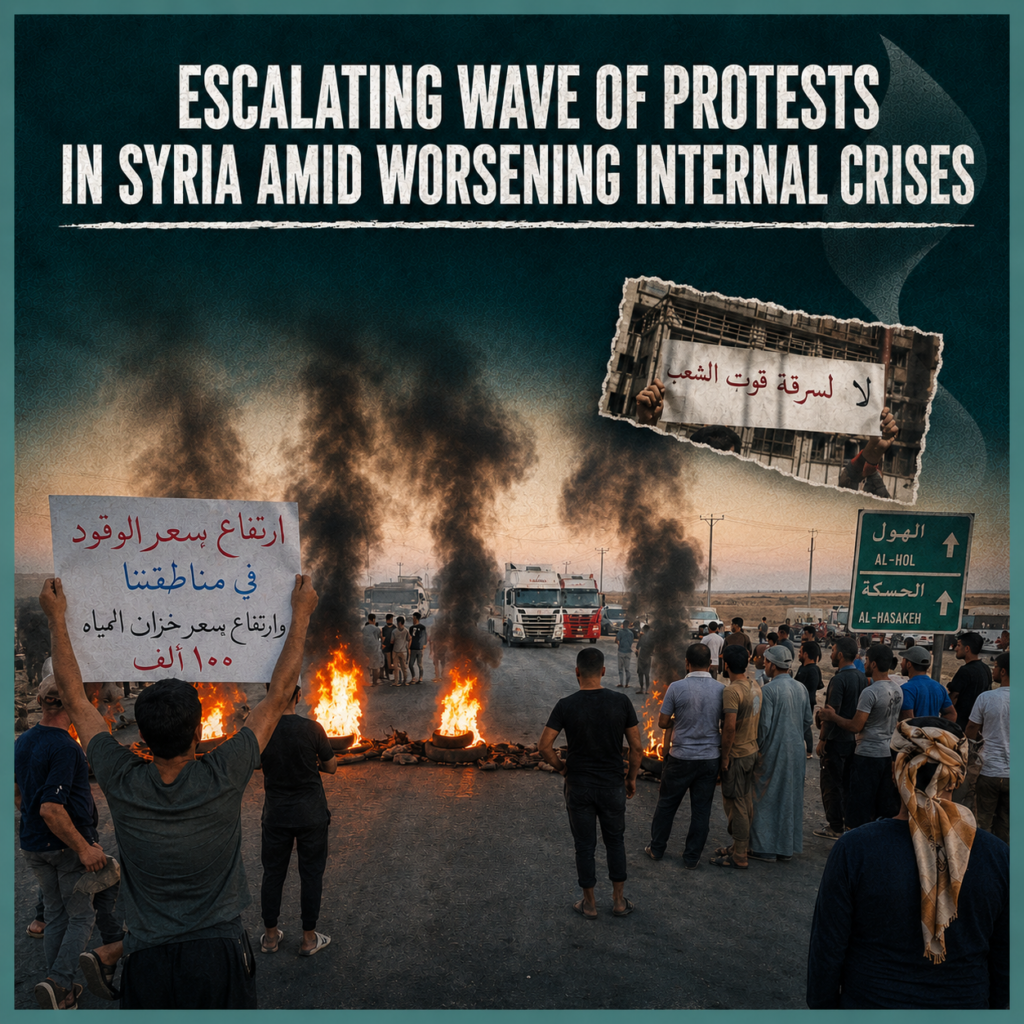
The Syrian arena is witnessing an escalating protest movement that reflects a deep crisis of trust between the public and the current government. Instead of presenting radical solutions for managing the country, the government is adopting policies that increase popular resentment, starting with the manipulation of accountability files, moving through administrative inability to provide basic services, and extending to economic decisions that further tighten the grip on Syrians. This escalating reality is confirmed by the latest reports issued by the Armed Conflict Location & Event Data Project (ACLED), which documented a notable surge in demonstrations during 2026.
Political Floundering and Circumventing Accountability
At the core of this movement, government floundering regarding the accountability file emerges as a primary factor in the instability. Despite the government’s attempt to project media victories—via the Ministry of Interior’s announcement in mid-June regarding the detention of more than 3,500 individuals holding military ranks in the former regime—these steps collided with widespread public rejection for being selective and unserious.
ACLED data recorded 41 demonstrations during the first half of June alone, constituting 40% of all protests in the country, with demands focused on condemning the government’s efforts to reintegrate and rehabilitate figures affiliated with the former regime. In this context, Muaz Al Abdullah, Middle East Research Manager at the project, explains that resentment is mounting due to the opacity surrounding the accountability process; the government is deliberately concluding non-transparent settlement agreements with military officials accused of crimes, in addition to completely ignoring the return of businessmen and investors who formed the financial front of the former regime, allowing them to resume their activities without any legal prosecution.
Administrative Paralysis and Marginalization of Affected Areas
The government’s failure is not limited to political transgressions but extends to the administrative and service management of the affected areas. The recent protests were geographically concentrated in the governorates of Aleppo, Idlib, Deir ez-Zor, Hama, Homs, and Rural Damascus; regions that have long suffered from destruction and displacement.
Instead of prioritizing these governorates in reconstruction plans, the government faces explicit accusations of negligence, dereliction, and severe delays in repairing basic infrastructure. This service marginalization has acted as an additional spark for the outbreak of protests, particularly in the city of Aleppo, which now lacks the most basic necessities of daily life, reflecting a glaring governmental inability to meet the simplest rights of citizens.
Economic Policies Threatening Food Security
In parallel with the service and political failures, economic decisions have deepened the scale of the crisis, exposing a severe mismanagement of local resources. Last May, ACLED documented 160 demonstrations across various Syrian regions, notably including 21 protests by farmers in the north and northeast of the country.
This movement emerged in rejection of unfair government policies, specifically the imposition of very low state-set procurement prices for wheat crops from farmers, which are incomparable to those adopted in neighboring countries. These decisions not only inflict heavy financial losses on farmers but also threaten the collapse of the agricultural sector and deal a fatal blow to the country’s food security, proving the disconnect between government planning and the deteriorating economic reality.
Field indicators and documented data confirm the current government’s lack of any actual strategy for managing the state properly. Ignoring popular demands, cementing a deliberate approach of “selective justice,” and the inability to control the escalating security breakdown, coupled with accumulated failures in economic and service administration, represent a trajectory that generates further resentment and exacerbates political and living crises rather than resolving them, thereby threatening to deepen the state of instability across the country.