
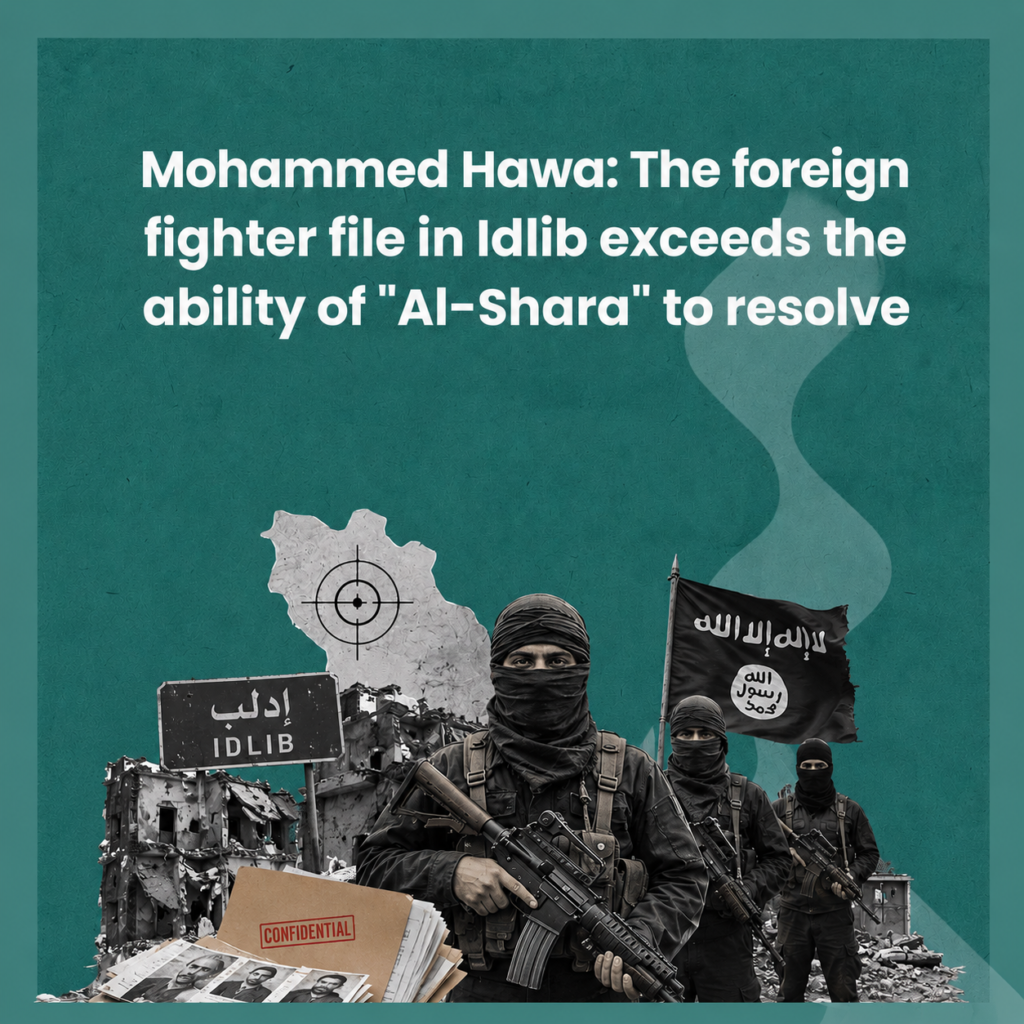
Over the past few hours, Idlib Governorate has transformed into an arena of open confrontation between the so-called “General Security” forces and groups of foreign fighters. This field escalation brings the “Migrants” (Muhajirun) file back to the forefront of the Syrian scene as one of the most complex and challenging issues facing the de facto authority in the region.
Direct Field Clash
The “General Security” forces launched a large-scale security campaign covering the outskirts of Idlib city and the towns of Kafriya, Al-Fu’ah, and Kafr Jalis, directly targeting fighters of Uzbek and Turkistani nationalities. The campaign, which included arrests and reported incidents of violent assault, was not merely a routine procedure. Instead, it escalated into intermittent clashes in the vicinity of Al-Fu’ah, coinciding with intense reconnaissance aircraft activity and the movement of heavy military convoys coming from Saraqib and Ariha.
Roots of Tension and Context of the Confrontation
The field tension emerged after the “General Security” apparatus detained a member of Uzbek nationality following a dispute with the agency in the town of Kafriya, rural Idlib. In response, the armed faction mobilized its cadres and besieged the “Criminal Security” headquarters in Idlib city, threatening direct military escalation and a raid on the building unless the member was released immediately. These developments reflect the growing state of congestion between foreign formations and the rest of the forces within Idlib.
Analytical Vision: A Complex File and International Calculations
In a reading of these developments, political analyst Mohammed Hawaidi views the foreign fighter file as one of the most complicated issues within the current power structure. Hawa highlights several fundamental points to explain this impasse:
-
Regional Cover: Hawa points out that some of these formations enjoy Turkish cover, making it difficult for “Al-Shara’” to terminate or address this file radically and independently.
-
Media Blackout and Lateral Interventions: The analyst notes the absence of official media coverage regarding the clashes with the Uzbeks. He points to the intervention of other militias to stop the attacks, reflecting overlapping loyalties and multiple centers of power.
-
Ideological Settlements: Hawa describes the presence of these groups as “ideological settlements” that will remain a major complex for Syrians and a significant long-term challenge.
Absence of a National Solution
Hawa concludes that dismantling these “settlements” and dealing with the complexities of the foreign fighter file requires the existence of a “national government and a national army“. He views this path as currently absent and unavailable, leaving the region hostage to field power balances and external interventions.
As the security alert continues in Idlib, questions remain regarding the ability of the de facto authority to contain this “internal explosion” without sliding into a comprehensive confrontation that could completely alter the map of influence in northern Syria.