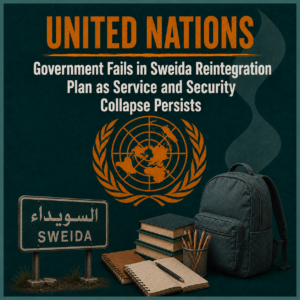
A UN briefing before the Security Council documents Damascus's failure to manage the Sweida crisis, as thousands of students are deprived of their education amid escalating security chaos and a political paralysis striking the institutions of the transitional authority.
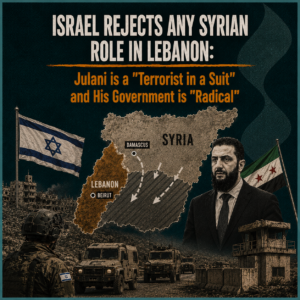
"A terrorist in a suit"... this is how the Israeli leadership summarized its view of Ahmad al-Sharaa's government in Damascus, coinciding with an extensive Israeli military expansion in southern Syria and a complete absence of an official response, amid field and diplomatic challenges that reflect the declining ability of the new Syrian leadership to manage the regional scene.
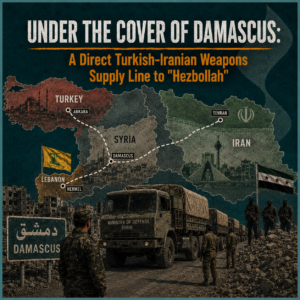
Through secret coordination between Ankara and Tehran to arm 'Hezbollah' via Syria, Syrian Ministry of Defense vehicles and local militias assume the task of providing logistical and security cover for military supplies; consequently, state institutions are exploited as executive tools to facilitate the deals of regional powers, at the expense of what remains of national sovereignty.
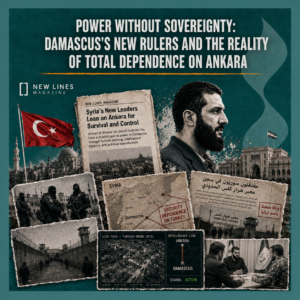
Damascus operates today under an authority lacking actual sovereignty, as the new leadership trades the country's independence for complete reliance on Turkish security tutelage. Based on a report by New Lines magazine, Ahmad al-Sharaa's government manages its affairs through political opportunism, navigating between its extremist past and the manipulation of alliances to ensure its survival in power at any cost.
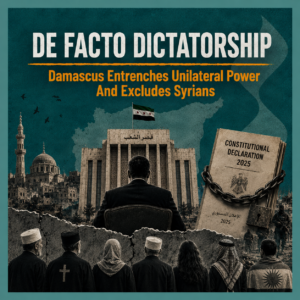
The Damascus government is confiscating the opportunities for political transition in Syria in favor of entrenching unilateral power that excludes Syrians. In the absence of any genuine constitutional and representative legitimacy, the new rule transforms into a de facto dictatorship that establishes absolute totalitarianism, placing the country on the brink of a new collapse.
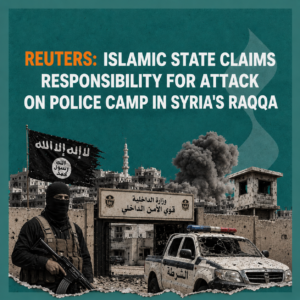
The recent attack claimed by the 'Islamic State' on an Interior Ministry headquarters in Raqqa, as reported by Reuters, demonstrates a clear failure in the current government's security strategy. This breach reveals the fragility of official agencies and their inability to secure their sensitive facilities, which weakens continuous claims about the return of stability and control.
Under the guise of implementing "transitional justice" and claims of discovering remains dating back to 2014, the city of Saidnaya is facing a security and economic siege that conceals real estate projects aimed at altering the demographics of the Christian town. This investigative report dismantles the contradictions within the official narrative and reveals the details of the urgent appeal issued by the international "Crisis Cell" to protect civilians, demanding immediate intervention to ensure the application of international humanitarian law.
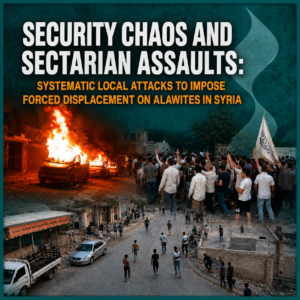
Dragging in the streets, burning of properties, and public threats of displacement; this is how local groups ravage Syrian cities in sectarian persecution campaigns directly targeting Alawites, entrenching a reality of security chaos that pushes the country toward a dangerous abyss amid a complete absence of the rule of law.
The Western Syria Development Organization (WSDO) has addressed an official letter to "The Tom Lantos Human Rights Commission of the U.S. House of Representatives" demanding concrete guarantees to protect Christians, Druze, Alawites, and Kurds before any diplomatic or economic normalization with Damascus.
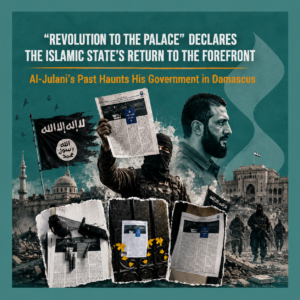
The "Islamic State" organization has launched a widespread paper propaganda campaign under the slogan "A Revolution to the Palace." The campaign, which originated in Daraa and expanded to mosques in northern Syria, constitutes an explicit declaration of the organization's return to the forefront. It proves that the government, which is seeking to whitewash its factional past by appeasing the outside world, stands powerless today in the face of the reverberations of extremism at home.
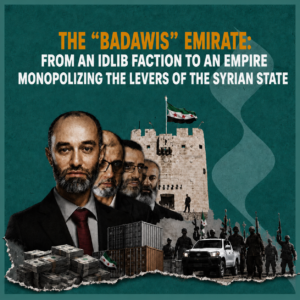
"The Badawis"... a hegemony legitimized by government decrees that exclude Syrians from their wealth, exploiting influence to swallow up the energy, customs, and contracting sectors, thereby reproducing financial despotism and regional marginalization under the transitional administration.


![An International Call from the "Crisis Cell [OCC]" to Protect Saidnaya's Christians](https://www.westernsyriadevelopment.org/wp-content/uploads/2026/06/يؤب-300x300.png)