Government practices through the "Anti-Illicit Enrichment Committee" reveal a contradiction and erratic implementation of stated laws. While authorities confiscate independent private sector facilities and strip their owners of the right to legal defense without definitive convictions, they simultaneously strike financial settlements with sanctioned figures tied to the former regime. This approach exposes clear selectivity, turning regulatory measures into a legal cover for financial extortion and the direct looting of private sector properties and institutions.
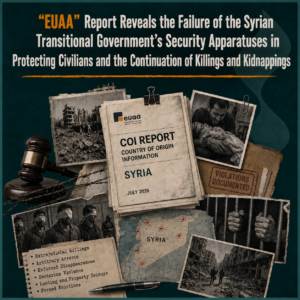
A recent report issued by the European Union Agency for Asylum (EUAA) reveals the continuation of systematic violations and the absence of the rule of law in areas controlled by the Syrian transitional government. The European report highlights the failure of military and security apparatuses to protect civilians, documenting extrajudicial killings, arbitrary arrests, kidnappings, and widespread looting. Furthermore, it underscores the escalation of ISIL (ISIS) activity, as the group exploits ongoing security vacuums to expand its attacks against both civilians and government forces across various Syrian governorates.
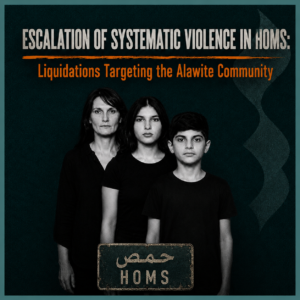
Homs Governorate and its countrysides are witnessing a dangerous escalation of organized crimes and direct liquidations targeting the Alawite community. This article details recent field attacks and assassinations, highlighting their connection to local networks operating with total impunity under the cover of de facto authorities, aiming to solidify a policy of forced displacement in the region.
In a sharp assessment of the political shifts in Syria, Sarit Zehavi, founder and president of the Alma Research and Education Center, asserts that Jolani's attempts to market himself internationally in diplomatic suits do not negate the fact that he continues his extremist approach to this very moment. Zehavi warns against the Western tendency to overlook his administration's supervision of 70 schools indoctrinating children with Al-Qaeda ideology, alongside Hay'at Tahrir al-Sham's responsibility for more than 600 documented terrorist attacks.
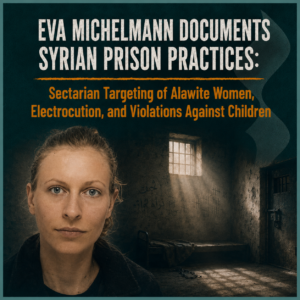
In a testimony documenting systematic violations within Syrian prisons, German journalist Eva-Maria Michelmann revealed a security reality that proves the continuation of repressive policies under the transitional authority. The testimony provided firsthand evidence of identity-based arrests targeting Alawite women, systematic torture by electrocution, and the detention of infants in cramped cells, concluding with a direct demand for Berlin to immediately halt the deportation of refugees to a country that remains "unsafe".
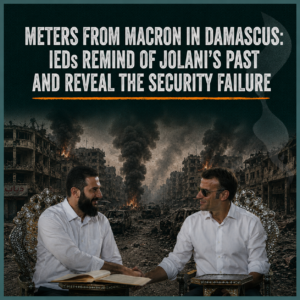
Four IEDs detonated in Damascus, just meters away from the residence of French President Emmanuel Macron. This field breach exposed the severe security failure of Ahmad al-Sharaa’s government in securing the capital, bringing Jolani’s jihadist past back to the forefront before the international community.
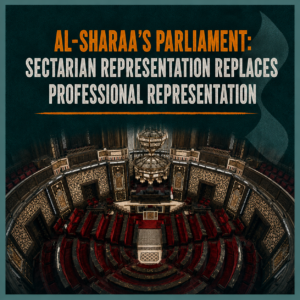
The formation of the new transitional parliament in Syria indicates that presidential appointments have entrenched executive centralization and transformed the "People's Assembly" into an arena for directed sectarian representation at the expense of professional sectors, amid the exclusion of pluralism and a clear marginalization of women and Syrian components.
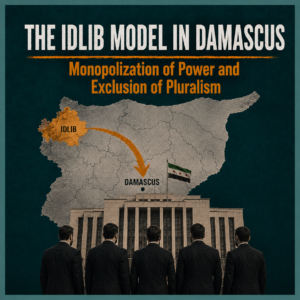
The recent appointments and reshuffles by the transitional authority in Damascus reveal a systematic strategy to monopolize the key pillars of the Syrian state by cloning the "Salvation Government" experiment from Idlib and mainstreaming its cadres on a national level. While some technocratic figures are utilized as an administrative facade, actual power is concentrated in the hands of a single security and military network. This excludes political pluralism and deepens international doubts regarding the new authority's capacity to build inclusive national institutions or secure any effective diplomatic recognition.
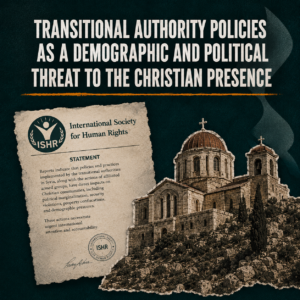
Reports and data from International Society for Human Rights (ISHR) document the direct repercussions of the Syrian transitional authority's policies and its affiliated militias on the Christian component. The decline in political representation, the absence of legal accountability, and property and security violations constitute a direct demographic and political threat to the Christian presence in its historical areas, necessitating international action regarding these developments and the country's political transition process.
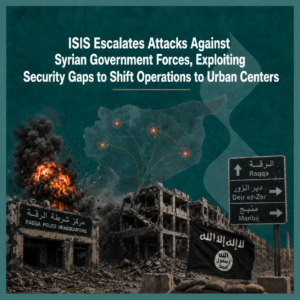
ACLED data documents a notable surge in ISIS attacks against Syrian government forces during the first half of 2026. The data illustrates how the group exploited the growing security vacuum and shortcomings to shift its offensive operations from desert regions to targeting fortified positions within urban centers, warning of an increasing frequency of bombings and attacks in the coming phase.
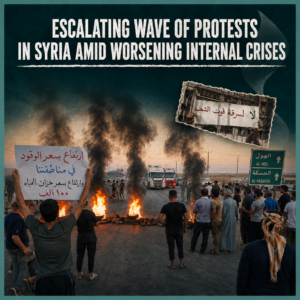
An ACLED report documents the escalation of protests in Syria due to current government policies. Economic failures, the absence of accountability, and the disregard for security and service crises emerge as the primary drivers of the new civil movement.
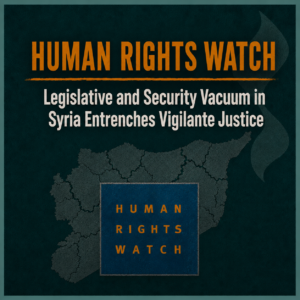
A Human Rights Watch report warned of the repercussions of the legislative vacuum and security shortcomings in Syria, following the documentation of revenge attacks and identity-based violence in Damascus and Idlib. The report emphasized that the authorities' failure to enforce the rule of law, relying solely on official statements, has led to a state of security breakdown and extrajudicial vigilante justice.