
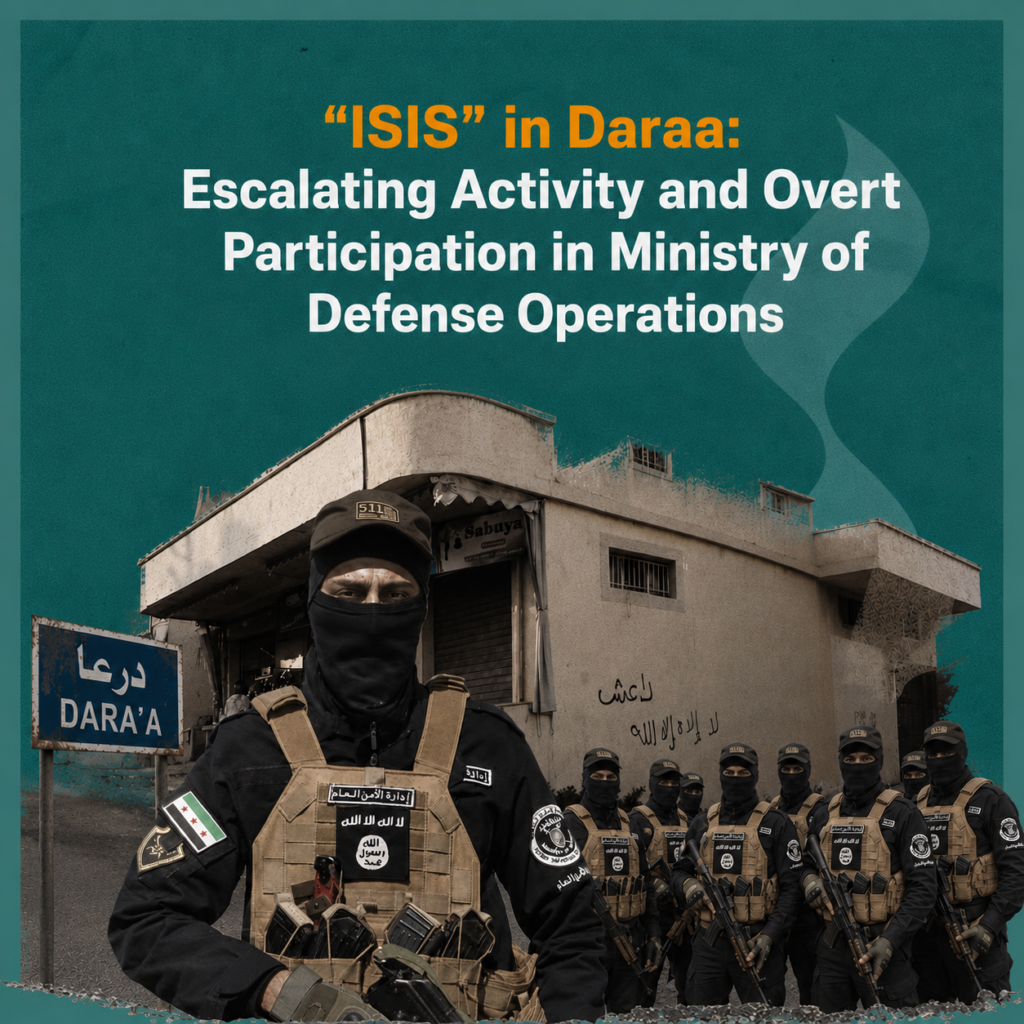
Daraa Governorate is no longer merely a geographical area suffering from chronic security disturbances; rather, according to documented security reports, it has transformed into a living laboratory for the resurgence of ISIS in a more dangerous, hybrid form. Field data from the “Middle East Center for Security Studies and Counter-Extremism” indicates that the organization is no longer just “sleeper cells,” but an entity infiltrating the infrastructure of security chaos in the region, benefiting from the convergence of its interests with those of local de facto powers.
Hybrid Networks: From Recruitment to Collusion Field monitoring reveals a complex structure for the organization in Daraa, which transcends the traditional model of armed activity. The organization has reorganized its ranks by merging the expertise of the former “Jaysh Khalid ibn al-Walid” with drug and arms smuggling networks. This logistical integration has provided the organization with vast financial resources and a cross-regional intelligence structure, exploiting the security vacuum left by the retreat of central state authority in favor of local security formations.
The Center has documented three active cell models, distributed geographically as follows:
-
Yarmouk Basin Cell (Southwestern Daraa): Operates in the towns and villages located in the far southwest of the governorate, an area characterized by the interweaving of agricultural lands with rugged valley networks leading to the borders.
-
Nawa and Tasil Cell (Western Countryside): Positioned near the city of Nawa (the largest city in the western Daraa countryside) and the town of Tasil (located southwest of Nawa), which are open rural areas connecting the western Daraa countryside with contact zones near the Yarmouk Basin.
-
Northeastern Countryside Cells: Active in areas bordering As-Suwayda Governorate, specifically on the outskirts of the Al-Lajat region—known for its complex volcanic, rocky terrain—in addition to growing activity in Al-Sanamayn (north of the governorate) and the town of At-Tayyibah (east of Daraa).
“The Dual Infiltration”: Intersection of Interests with Public Security This study presents a startling hypothesis regarding the nature of the relationship between ISIS and the “Public Security” and Ministry of Defense formations affiliated with the government of Ahmad al-Shara’ (known as Al-Jolani). Field evidence—documented through photos and videos—shows armed elements wearing official security insignia alongside the appearance of ISIS symbols.
This overlap does not merely reflect an administrative malfunction; it indicates a policy of “security investment” pursued by the incumbent authorities, where extremism is overlooked and employed in battles against local parties or minorities (as seen in the case of As-Suwayda) in exchange for a field cover granted by these agencies to extremist elements. The appearance of ISIS symbols alongside Ministry of Interior insignia during attacks against Druze civilians serves as a dangerous indicator of the deviation of the security mission, transforming it into a tool serving sectarian and extremist agendas.
Shift Toward “Overt Control” The organization has transitioned from a phase of clandestine activity to a show of force. In cities such as Al-Sanamayn and the town of At-Tayyibah, the organization’s presence is no longer secret; reports have documented slogans written on the walls of schools and government buildings asserting the organization’s persistence and expansion. This visual presence reflects a growing confidence among the organization’s elements that the security environment is incapable of deterrence, as a result of either the infiltration of these apparatuses or their deliberate leniency.
What the Syrian South is witnessing today represents an early warning of the formation of an organized jihadist network exploiting the current chaos to entrench its influence. The style of security management based on “co-opting extremists” rather than dismantling them places the region before existential risks; as the loss of public trust in security forces and the transformation of cities into fronts for sectarian conflict creates an incubator environment for recruitment and radicalization projects. Consequently, this security collusion not only threatens the stability of Daraa but grants ISIS a “legitimate cover” to operate and rebuild its structure under the auspices of entities ostensibly tasked with counter-terrorism, thereby solidifying the Syrian arena as a permanent hub for transnational crime and organized terrorism.