
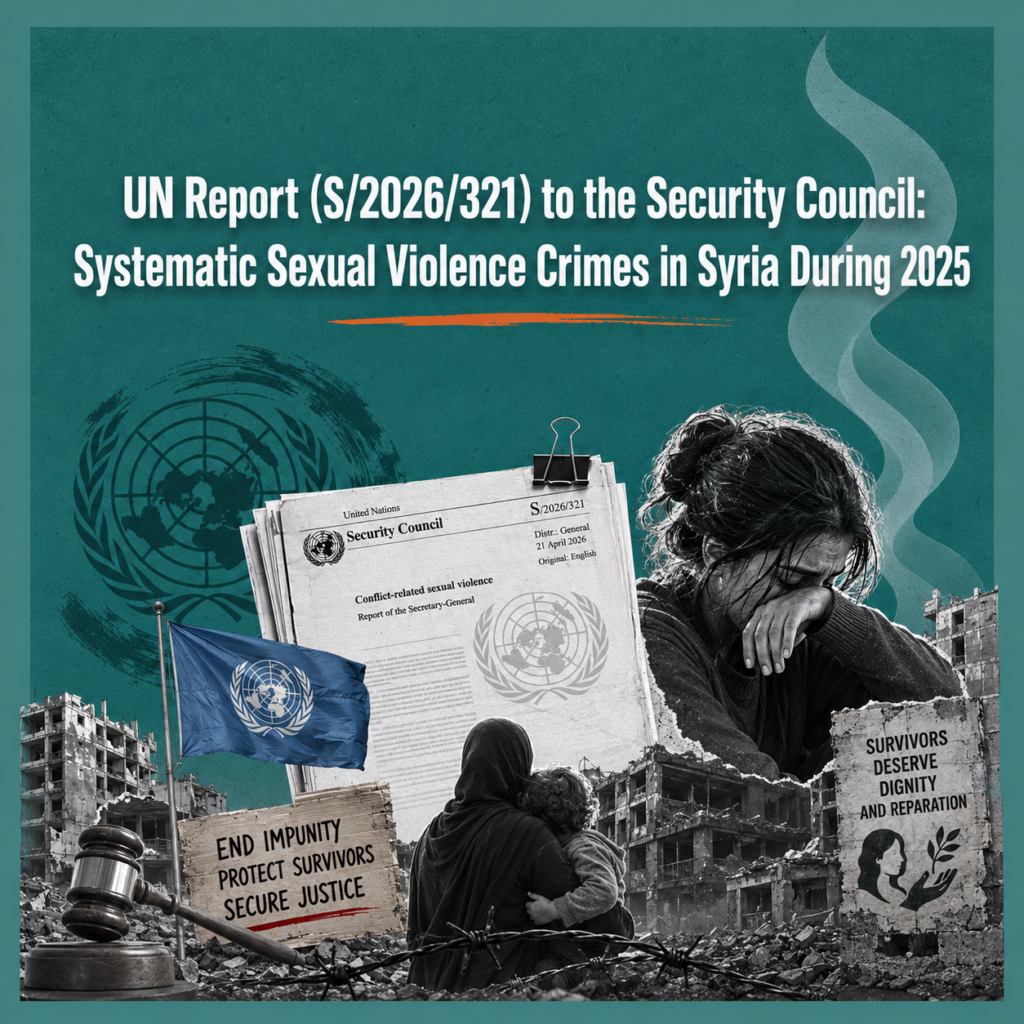
In his annual report (S/2026/321) to the Security Council, the UN Secretary-General opens the file on sexual violence in Syria during 2025, documenting coercive sexual practices that have specifically targeted women from minority groups. The report reveals that the bodies of these women continue to be violated as a systematic tool of repression and a means to attack identity, placing the international community before a human rights imperative that cannot be delayed in confronting these crimes and holding those responsible accountable.
Parties Involved in Violations:
The UN report lists specific parties as “credibly suspected” of committing or being responsible for patterns of rape and other forms of sexual violence. This list includes: Ahrar al-Sham, Jaysh al-Islam, ISIS, and Hay’at Tahrir al-Sham.
2025 Practices (UN Documentation):
The report confirms that sexual violence continued as a systematic tool during 2025, with practices categorized into the following areas:
-
Continuing Sexual Torture: The report confirms the documentation of cases of sexual torture targeting men and boys in detention centers, emphasizing that these practices are ongoing and used as a tool to subjugate detainees.
-
Violence Directed Against Minorities: The report documented systematic crimes consisting of cases of abduction, rape, and forced marriage affecting women from the Alawite and Druze communities, as part of an organized hostile policy targeting these components with grave violations that cannot be separated from their systematic context.
-
Collective Sexual Violence: The report pointed to the involvement of armed groups still active on Syrian territory in incidents of sexual violence, documenting cases involving extremist groups, including ISIS, in addition to armed elements linked to the “Syrian National Army,” which were described as grave violations.
-
Obstacles to Accessing Justice: The report explained that survivors in 2025 faced doubled obstacles, as security fears and social stigma prevent them from seeking legal assistance, making the documentation of these crimes an extremely difficult and complex process.
Operational and Service Gaps:
Based on the report’s analyses, the Syrian situation in 2025 was characterized by sharp structural gaps hindering paths to redress:
-
Collapse of Support Networks: Medical and psychological services dedicated to survivors continue to suffer from a severe shortage, given the lack of qualified personnel in affected areas to deal with the trauma of grave sexual violence.
-
Legal Dilemma: The report criticized the continued existence of loopholes in current Syrian legislation, as legal definitions of rape remain narrow and fragmented, hindering the prosecution of perpetrators and reducing the chances of obtaining fair judicial verdicts.
-
Risk of Impunity: The report stressed that the absence of a comprehensive and independent transitional justice mechanism means the continued suffering of survivors without hope for real reparation or legal recognition of the violations.
UN Recommendations for the Transitional Phase:
The Secretary-General has set a roadmap for addressing this file in Syria, including the following recommendations:
-
Meaningful Participation: The necessity that any transitional justice process includes direct participation from survivors and Syrian women’s organizations to ensure “transformative” justice, so that it does not merely settle for punishment but addresses long-term damage.
-
Prosecuting Perpetrators: Emphasizing the principle that sexual violence crimes should not be included in any “general amnesty” or political settlement agreements, with the necessity of holding perpetrators accountable regardless of their rank or affiliation.
-
Reparation: Calling for the creation of legal frameworks that provide material and psychological compensation to survivors and children born as a result of rape, while ensuring their rights to citizenship and education.
-
Ensuring Safe Access: Demanding that active authorities ensure safe and unhindered access for humanitarian and human rights organizations to detention centers to ensure the exposure of any ongoing violations.
The UN Secretary-General’s report (S/2026/321) places the international community before its legal and moral responsibilities, confirming that sexual violence in Syria is not merely a transient violation, but a systematic crime requiring a decisive response, and that achieving justice for survivors can only be realized by establishing independent judicial mechanisms that are not subject to any political settlements and ensure the accountability of all parties involved without exception.