
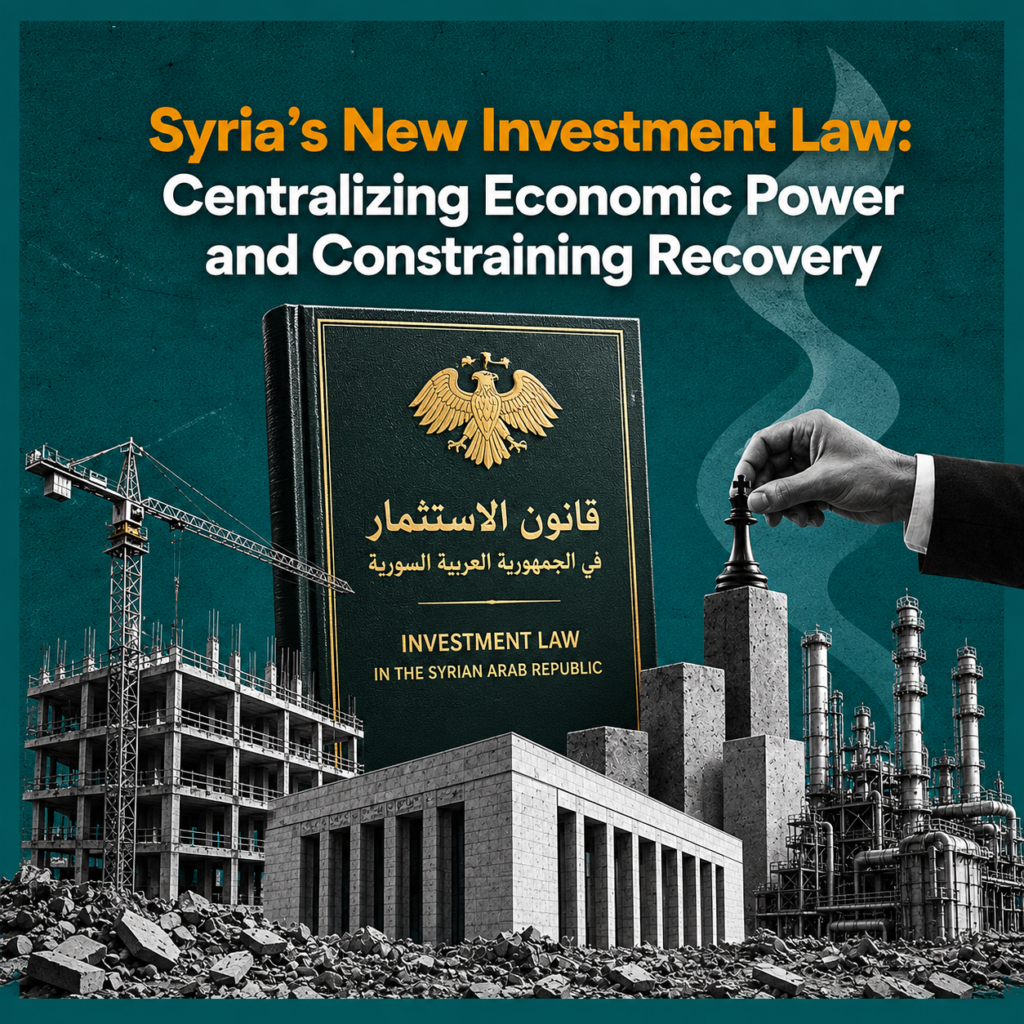
As Syria navigates the early stages of its postwar period, “Investment Law No. 114,” enacted by President Ahmed al-Sharaa, has raised fundamental questions about the country’s economic trajectory. While official bodies promote the law as a primary tool for attracting foreign capital and catalyzing reconstruction, critical analysis of the legal framework suggests that it reinforces centralized control mechanisms, thereby weakening market competitiveness and limiting prospects for sustainable economic recovery.
Centralization as a Mechanism of Economic Governance
The new law establishes a centralized licensing system that bypasses traditional ministerial authorities, placing both the “Supreme Council for Economic Development” and the “Syrian Investment Authority” (SIA) directly under the presidency. Observers note that this administrative structure grants the executive branch sweeping power to determine “who is eligible to invest,” making access to strategic assets—such as state-owned land and vital economic sectors—dependent on criteria that are frequently non-economic. This pattern, which links competitive licensing to the discretion of the granting authority, diminishes the autonomy of the business environment and renders it increasingly vulnerable to political alignment.
Investment Incentives Beyond International Standards
The law offers a package of generous incentives, including permanent tax and customs exemptions for specific industrial and agricultural sectors. While incentivizing investment is crucial in post-conflict contexts, the absence of “sunset clauses” (expiration dates) for these incentives is an economic anomaly. Instead of linking benefits to specific developmental goals or performance benchmarks, the law grants open-ended advantages that could erode the state’s tax base, thereby depleting the fiscal revenues essential for financing public services and future reconstruction.
Entrenching Dominance and Marginalizing Competitiveness
In practice, the law fosters an uneven playing field. While doors are opened to foreign firms and major entities with structural ties to the centers of power, local small-scale and new investors face significant barriers to entry, as access to incentives and assets remains subject to exceptional considerations. This model reproduces a system of mutual benefit between specific economic elites and state institutions—often referred to in economic literature as “crony capitalism”—which frequently stifles the private sector and marginalizes firms that lack political backing.
Challenges of Structural Reform
Economic experts emphasize that rebuilding Syria requires a transition from a system of “mediated economic access” to a “rules-based system.” To mitigate the risks inherent in the current framework, the report suggests several reform paths:
-
Performance-Linked Incentives: Capping tax exemptions at 10–15 years and conditioning extensions on performance metrics such as employment, technology transfer, and local sourcing.
-
Adopting a “Negative List” System: Opening the market to investment by default, limiting state-authorized licensing only to a narrow range of strategic sectors subject to transparent competitive review.
-
Decentralizing Authority: Transferring oversight of licensing to specialized, administratively independent regulatory bodies to reduce the executive branch’s direct influence over routine economic decisions.
In summary, Investment Law No. 114 represents a strategic choice for the Syrian authorities, yet its current features reinforce the centralization of economic decision-making, leaving it hostage to political considerations. While the country is in urgent need of capital inflows, the fundamental challenge extends beyond merely offering incentives; the success of reconstruction depends on the authority’s ability to shift from a model of “mediated access” to an economic system governed by clear, independent rules. Quality, sustainable investment requires an environment that grants opportunities based on competitiveness and efficiency rather than proximity to centers of power. Therefore, reviewing the current administrative mechanisms and dismantling centralized licensing are indispensable steps to ensuring that investments serve as a lever for national development rather than a tool for entrenching economic influence within a narrow circle.