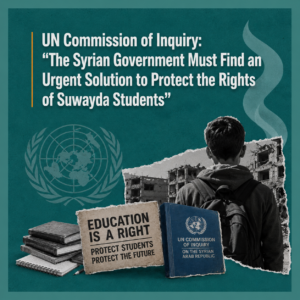
The UN Independent International Commission of Inquiry has called for urgent intervention to end the Suwayda exams crisis, stressing the need to protect students' right to education and shield it from any political considerations. The Commission warned that continuing to deprive students of access to their exam centers due to security risks and barriers will only cement divides, holding the Syrian authorities responsible for finding an immediate solution that safeguards civilian rights and ensures their safety.
"Monte Carlo": The boycott campaign against Alawites in Syria parallels the Nazi regime's campaigns to boycott Jews in Germany, which paved the way for apartheid laws and the Holocaust.
A wave of silent and public assassinations is hitting prominent military and security figures across Syria. Damascus is restructuring its new security apparatus, getting rid of its old guard through fake medical reports citing "heart attacks" and deadly ambushes registered against "unknown perpetrators.
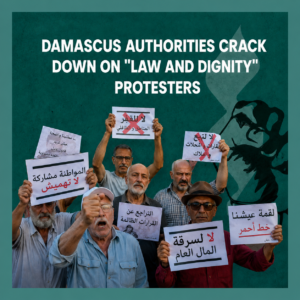
In a scene embodying double standards amidst an unprecedented economic collapse, security forces in Damascus ended the peaceful 'Law and Dignity' sit-in by threatening participants with arrest, while providing protection for a pro-government rally chanting sectarian slogans and openly mocking the pain of Syrians.
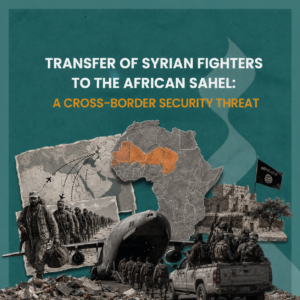
The military influence of Syrian fighters is expanding beyond regional borders, as recent developments have revealed the transfer of armed groups from the Aleppo, Idlib, Hama, and Damascus countrysides to countries in the African Sahel (Niger, Mali, and Burkina Faso). In this context, Middle East affairs expert Walid Phares described these fighters as having transformed into a 'transnational tool of terror' within a global network that now poses a direct threat to the stability of the Sahel region.
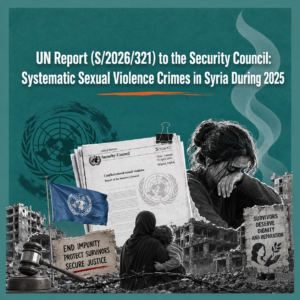
The UN Secretary-General’s report (S/2026/321) documents systematic sexual violence in Syria during 2025, revealing the deliberate targeting of Alawite and Druze women through crimes including abduction, rape, and forced marriage.
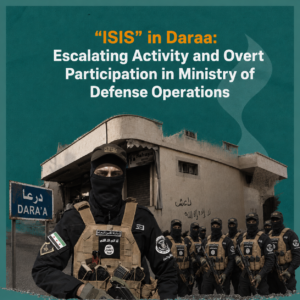
"ISIS" activities in Daraa are expanding from clandestine operations to overt participation in military operations alongside Syrian Ministry of Defense formations. This field coordination grants extremists official cover, turning southern Syria into an arena where terrorist groups integrate with state institutions and threaten the stability of the entire region.
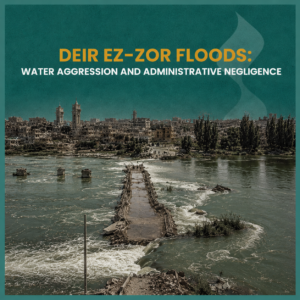
The villages of Raqqa and Deir ez-Zor are drowning under the Euphrates floods, in a disaster where Turkish water control policies intersect with Syrian institutional failure. The surging waters have claimed lives, collapsed vital bridges, and crippled water stations, leaving residents to face displacement and flooding on their own, with a total absence of evacuation plans or official response to protect civilians from the consequences of this negligence.
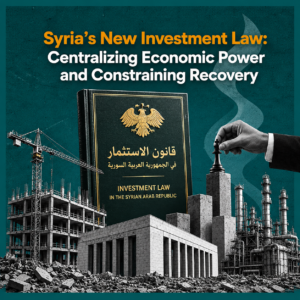
"Investment Law No. 114" establishes an economic system based on 'directed access' rather than market competitiveness. By granting the executive branch absolute control over licensing and strategic assets, the law entrenches the influence of specific economic elites and drains state revenues through unconditional, open-ended tax exemptions. Successful reconstruction depends on ending this centralization and adopting a transparent, rules-based system that effectively separates political authority from commercial activity
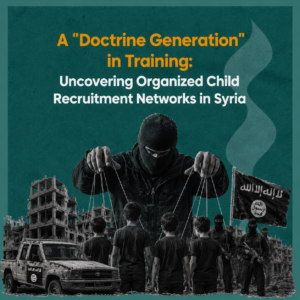
A report by the 'Middle East Center for Security Studies' reveals an organized child recruitment network in Syria, operating in direct partnership between official institutions (the Ministries of Defense and Interior) and ideological factions; as Sharia schools and closed camps are being exploited to transform minors into a 'combat core' through ideological brainwashing and military training
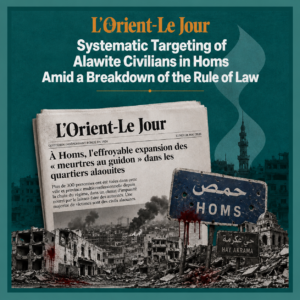
"L’Orient-Le Jour" covers the systematic assassination operations targeting Alawite civilians in Homs, which have become a daily pattern of terror. Amidst the absence of accountability and the rule of law, the city’s residents face chronic security lawlessness, placing the de facto authorities under direct legal and moral responsibility for this ongoing bloodshed and their failure to protect civilians
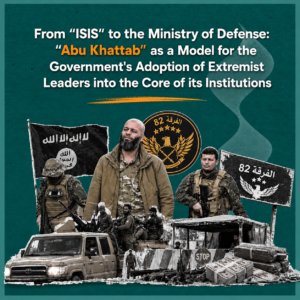
From hardline jihadist circles to leadership positions in the Ministry of Defense, 'Abu Khattab's' trajectory cements the ideological nature of the Syrian de facto authorities. Integrating leaders with 'ISIS' backgrounds into the core of official institutions is the true expression of a state structure that adopts extremism and embeds it as an integral part of its governance