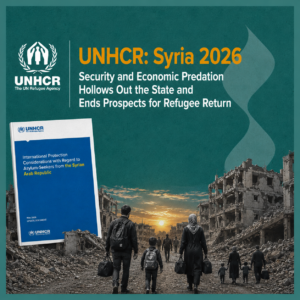
The UNHCR report confirms that Syria has transformed into a "hostile environment" due to a comprehensive institutional, security, and economic collapse, alongside the absence of "legal certainty." The report documents that the encroachment of security apparatuses and militias into civil life is not a series of isolated incidents, but a general policy that has turned the state into a source of threat rather than a guarantor of rights.
In light of this security exposure and the authorities bearing responsibility for the systematic violations committed against minorities, the report warns that these groups may be driven toward existential choices, such as forming self-defense groups, demanding autonomous governance, or seeking international protection. The UNHCR's warnings against calls for "mass returns" emphasize that the obligation to uphold the principle of "non-refoulement" is an indivisible international legal duty that cannot be bypassed in the face of a regime that has lost both the capacity and the will to protect its citizens.
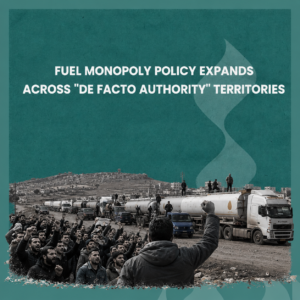
The fuel monopoly policy managed by the 'de facto authority' is expanding from Idlib to the Aleppo countryside, replacing local facilities with centralized control. As residents protest these restrictions, they are met with security measures, marking a shift in management that consolidates resources under the authority’s institutions and limits independent market alternatives
The Syrian stance places Berlin and the European Union in a strategic impasse following Damascus's rejection of plans to repatriate over 700,000 Syrian refugees. Migration is no longer just a negotiation file; it is an instrument of influence in the hands of the 'Hay'at Tahrir al-Sham' authority, which manages its networks in Europe as an 'organic extension' of its political project. This development ends the European bet on legitimacy as a means of resolution and opens the door to a new security reality at the heart of the continent
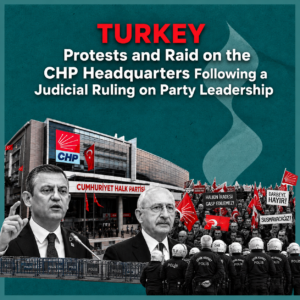
On May 24, 2026, the headquarters of the Republican People’s Party (CHP) in Ankara witnessed a security intervention following a judicial ruling to restructure the party’s leadership. This report analyzes the systematic employment of judicial and security tools to undermine opposition strongholds, specifically targeting political entities with significant popular bases through coercive administrative measures. The briefing concludes that this development reflects the domestic application of 'conflict management' strategies previously employed by the Turkish authorities in regional contexts, signaling a strategic shift toward weakening the independence of Turkish political institutions and marginalizing their public influence
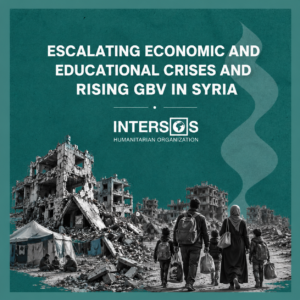
A recent report by the INTERSOS organization reveals the continued deterioration of living conditions for Syrian families returning to their areas of origin. The report documents structural crises including economic collapse, the degradation of educational infrastructure, and high rates of gender-based violence, in addition to legal and security obstacles that prevent returnees from achieving stability and meeting their basic needs
This article deconstructs the narrative recently propagated by New Lines Magazine, which labels the Sweida governorate as a 'narcotics capital.' By analyzing the ground realities and the absence of the industrial infrastructure required for such large-scale production, this investigation exposes the mechanics of 'media recycling.' It demonstrates how investigative reports are strategically instrumentalized to serve specific political agendas. The analysis concludes that such narratives are designed to demonize the province, laying the groundwork to justify future security campaigns under the pretext of 'counter-narcotics' efforts.
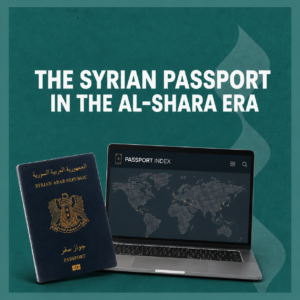
The 2026 Passport Index shows that the Syrian passport continues to decline, ranking among the weakest globally in terms of freedom of movement and visa-free travel, These results highlight the gap during the 'Al-Shara era' between official rhetoric regarding state prestige and the diplomatic reality; the low ranking reflects the ongoing legitimacy crisis that imposes international isolation on Syrian documents and restricts citizens' mobility.
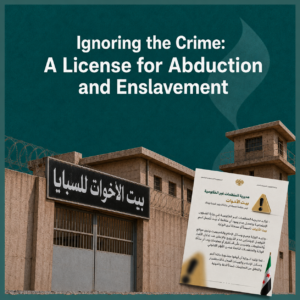
Amid intensifying demands to uncover the fate of the forcibly disappeared, the Ministry of Social Affairs simply claims: "The Sisters' House is neither licensed nor registered." This administrative denial is not a solution to this violation; it is blatant complicity. Instead of pursuing the crimes of enslavement and disappearance, the state hides behind "paper records" to justify its inaction, transforming its institutions into a cover that shields the perpetrators instead of protecting the victims
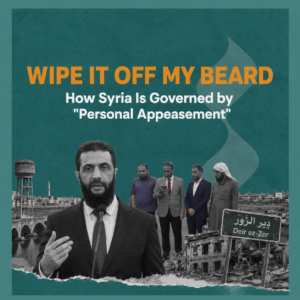
The de facto authority replaces the rule of law with the leader’s promises and the logic of 'personal patronage,' transforming the region into a private fiefdom where institutions are absent. The dignity of Syrians is reduced to appeasement-based promises that entrench authoritarianism and dismantle the concept of citizenship
Regionalist remarks by Al-Julani’s father have ignited a firestorm of outrage and mass protests in Deir ez-Zor. These insults to the Syrian social fabric forced Al-Julani into a desperate apology, coming at a time when the region is already simmering with economic discontent and unrest
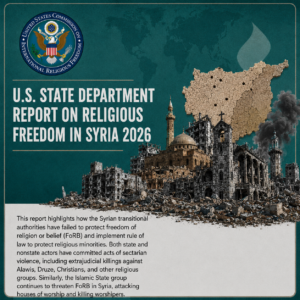
The 2026 U.S. State Department report reveals critical failures by Syria's transitional authorities to protect religious minorities and uphold the rule of law. Documenting ongoing sectarian violence and the rising influence of extremist factions within the state apparatus, the report warns that Syria is becoming an environment that repels minorities amid entrenched impunity and persistent terrorist threats.
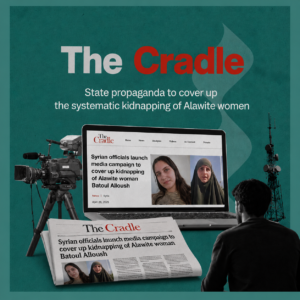
An investigation by The Cradle exposes an official media and security campaign to cover up the kidnapping of student Batoul Alloush, as international documentation of similar cases places the Syrian government under global scrutiny for systemic sectarian abductions