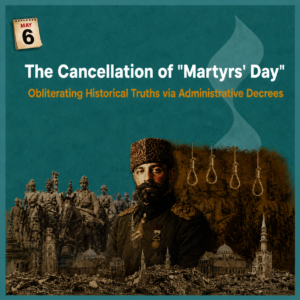
The cancellation of the May 6th holiday constitutes the obliteration of a foundational historical milestone linked to the resistance against Ottoman despotism and the 1916 executions in Damascus and Beirut.
This administrative measure reflects a trend towards reshaping collective memory and marginalizing unifying national symbols, lacking official justification and infringing upon the right of peoples to preserve their historical heritage and national identity across political shifts.
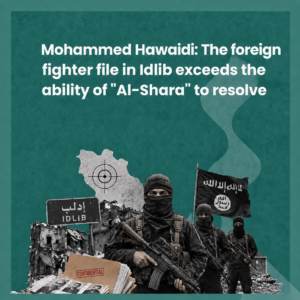
Field escalation in Idlib pits "General Security" forces against foreign fighters. Political analyst Mohammed Hawaidi describes these groups as "ideological settlements" that remain impossible for "Al-Shara'" to resolve due to regional cover, asserting that dismantling this complex file requires a national government and army.
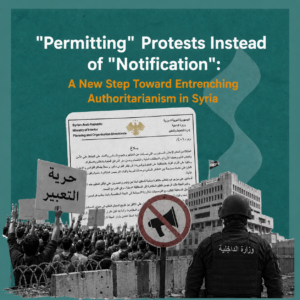
The new circular issued by the Syrian Ministry of Interior, which imposes a “permit” system for peaceful demonstrations and public gatherings, has raised growing concerns about the future of public freedoms and the right to expression in the country. Critics argue that transforming protest from a fundamental constitutional right into an administrative privilege subject to official approval represents another step toward reinforcing a security-driven approach and deepening authoritarian control, at a time when several Syrian regions are witnessing demands-based protests and worsening economic crises.
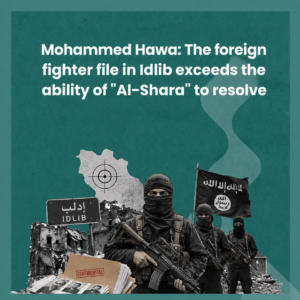
Field escalation in Idlib pits "General Security" forces against foreign fighters. Political analyst Mohammed Hawaidi describes these groups as "ideological settlements" that remain impossible for "Al-Shara'" to resolve due to regional cover, asserting that dismantling this complex file requires a national government and army.
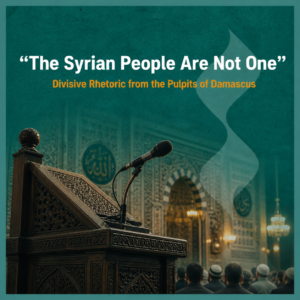
Alaa al-Din al-Sayeq from the Al-Iman Mosque pulpit in Damascus: A face of a shifting religious discourse that sets 'affinity' aside to adopt a language of 'exclusion' as dictated by the current phase. It is a systematic strategy to weaponize pulpits in shredding what remains of a collective Syrian identity, turning houses of worship into official platforms for institutionalizing division and priming society with enduring sectarian and social friction.
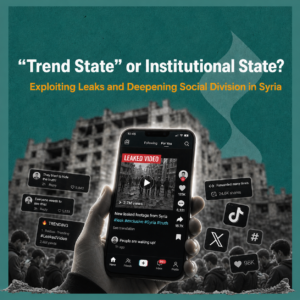
Statements by Rami Abdel Rahman on Syria’s reality as a "Trend State" driven by orchestrated leaks. He highlights the exploitation of regional dialects to divert attention from core human rights issues, asserting that genuine justice lies in institutional accountability rather than sectarian incitement.
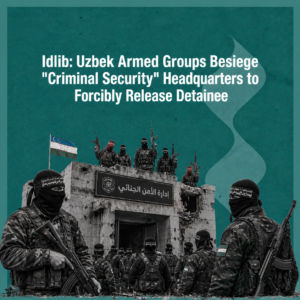
The siege of the 'Criminal Security' headquarters in Idlib by **Uzbek jihadist groups** reveals the **government's inability** to control these entities or hold them accountable. This incident highlights the state of security chaos and the bypassing of executive institutions by armed groups, rendering the language of arms the primary tool for resolving disputes and circumventing legal frameworks.
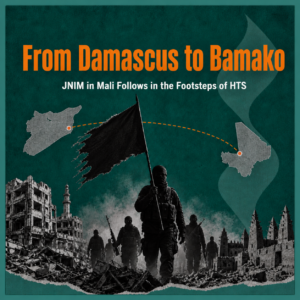
"As Hay’at Tahrir al-Sham (HTS) was shaping the transition of power in Syria in December 2024, the Group for the Support of Islam and Muslims (JNIM) in Mali was closely observing the experience to draw its own lessons. This article moves beyond traditional military analysis to reveal how the Sahelian group is adopting the same 'organizational doctrine' pursued by HTS; where the objective centers on positioning itself as the sole sovereign power capable of filling the vacuum the moment the state vanishes. It is an investigation into the transformation of these movements from insurgent groups into 'successor entities' awaiting the decisive moment to announce the ready alternative."
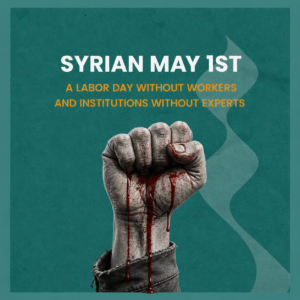
As the world celebrates Labor Day, Syrians face a tragic "Systematic Exclusion" that has displaced hundreds of thousands of workers. Through arbitrary dismissals based on sectarian identity and political loyalty, de facto authorities are stripping institutions of their national expertise, in a deliberate attempt to dismantle the state’s identity and future.
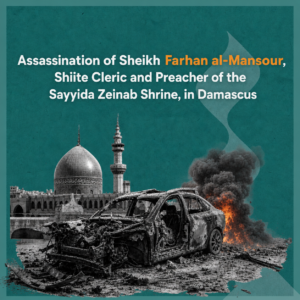
An assassination in Damascus targeting Sheikh Farhan al-Mansour, a prominent Shiite cleric and preacher at the Sayyida Zeinab Shrine, has sparked renewed fears over the safety of religious minorities.
The hand-grenade attack underscores the prevailing security vacuum and the growing threats facing religious icons in a landscape marked by a lack of accountability and institutional fragility
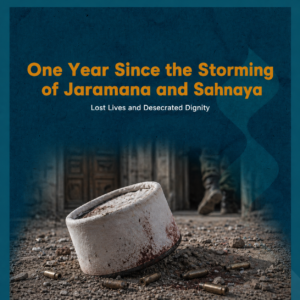
One year after the Jaramana and Sahnaya massacres. Behind the 'outlaws' narrative, a bloody incursion unfolded—an orchestrated campaign of strife and field executions targeting civil peace in the Damascus countryside and Southern Syria
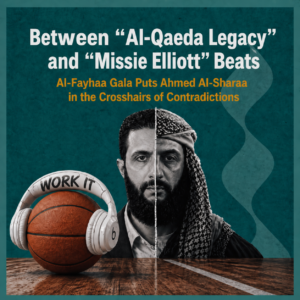
Between Missy Elliott's beats and an Al-Qaeda legacy: A DW report highlights the contradictions of Ahmed Al-Sharaa’s appearance at the Al-Fayhaa gala in Damascus. The article examines the controversy surrounding the foreign song within the context of seeking international legitimacy and the gap between an ideological past and the image currently projected to the world.